Today's
EarthStation1.com 15% Off Commemorative Memorial Title: The
Capitalist Cartoons Of John Sutherland MP4 Video Download DVD
Today, January 8, 2026
January 8: Show And Tell At Work Day: --
Today's objective is to rekindle the childhood excitement around
show & tell day during kindergarten. This day invites those
who long for the nostalgic event. This celebration was created
with the belief that age and maturity have no business robbing
people of joy. Thus, it is the best day to exhibit any trinket or
position that people may have the desire to showcase to their
colleagues. Show and Tell At Work Day was established by Thomas
and Ruth Roy to allow adults to momentarily feel like kids again.
Show and tell is the practice of showing an object to an audience
and describing it to them. It is a reasonably common classroom
activity in elementary school, especially in Western countries.
The objects displayed are usually toys or other children-oriented
items. In a regular show and tell session, children usually
present an item to the rest of the class and explain why that item
was selected, what it means to them, and other relevant
information. While the exact origins of the activity are unknown,
one of the first references to show and tell was in the 1954
journal "Childhood Education." The activity can help
children build storytelling abilities, bridge the school and home,
encourage bonds with one another, and enhance their communication
skills. A teacher's level of involvement may vary, but a 1994
research found that more involved teaching can increase the
psychological benefits of the activity for students. However, show
and tell has been criticized for how time-consuming and monotonous
it can potentially be. This activity, though, is usually limited
to childhood in most conventional cases. To combat this fact, Show
and Tell At Work Day was established by Thomas and Ruth Roy to
allow adults to momentarily feel like kids again. They are the
pioneers of wellcat.com and are known to begin several fun
holidays such as Be A Dork Day and Embrace Your Geekness Day.
Being an adult can be exhausting at times, especially if you are
working hard almost every day of the week. This day aims to help
us and our colleagues relive childhood fun. Show and Tell At Work
Day is a nostalgic event most would definitely enjoy celebrating.
On Sale @ 15% Off Discount Till Midnight PT!
https://store.earthstation1.com/capitalist-cartoons-us-probusiness-propaganda-animation-dvd.html
Today's
EarthStation1.com 15% Off Commemorative Memorial Title: American
Business Films Of The 20th Century MP4 Video Download DVD
Today, January 8, 2026
January 8: Typing Day: -- A significant
day not because it honors an important figure, or a landmark
historical event, or even the birth of a religious leader --
significan because because it celebrates the ability to type and
communicate with one another. Why is typing important, you may
ask? Think about it. How did you get here? You went onto your
phone, iPad, or computer and typed something into the browser.
Now, you're here, reading about typing. Groundbreaking, isn't it?
But in all seriousness, the incredible leaps we have made in
communication and written skill is something to celebrate, which
is why World Typing Day is such a great way to remember the past,
honor the present, and marvel at the future. If you ask someone
what comes to mind when they hear the word 'typing,' you will get
various responses. Some might immediately think of texting or
sending an email. Others might be inspired to reminisce about the
old days when significant businesses and agencies still employed
typists before they became known as secretaries and took on more
responsibilities than just typing. And those with more imagination
might see the image that has been portrayed by many films and
television shows of a writer perched on their desk chair typing up
a novel on an old-school typewriter. But first, back to where it
all began. The first commercial typewriters were introduced in
1874 and did not become widely used in offices until the
mid-1880s. Following this invention, typing as an art form and
essential skill in a changing world became highly sought after by
many traders, businesses, and publishers. It created millions of
jobs across the globe and taught generations how to type, put
together concise, informative written documents, and fostered a
whole new mode of written communication. Typing Day, which honors
a written form of communication that ensures speed, accuracy, and
efficiency, was established in Malaysia and is today celebrated
around the globe. The Malaysian Speed Typing Contest, which took
place in 2011, was the first event that cemented Typing Day as an
essential addition to calendars worldwide. Today, we don't even
think about it. We pull out our phones or log into our emails at
our desktops, and perhaps some of us still dust off our
typewriters. All to do one singular thing; type words to
communicate a message, feeling, or narrative. On Sale @ 15% Off
Discount Till Midnight PT!
https://store.earthstation1.com/american-business-films-1910s1960s-3-dual-laye191019603.html
Today's
EarthStation1.com 15% Off Commemorative Memorial Title: Fall Of
The Great Society & The Silent Majority: LBJ & Nixon MP4
DVD
Today, January 8, 2026
January 8: War On Poverty Day: -- January
8, 1964: The State Of The Union Address (SOTU): State Of The Union
Addresses: The 1964 State Of The Union Address: The Great Society:
The War On Poverty: -- President Lyndon B. Johnson declares a "War
On Poverty" in the United States, the unofficial name for
legislation first introduced by United States President Lyndon B.
Johnson, during his State Of The Union Address on Wednesday,
January 8, 1964. This legislation was proposed by Johnson in
response to a national poverty rate of around nineteen percent.
The speech led the United States Congress to pass the Economic
Opportunity Act, which established the Office of Economic
Opportunity (OEO) to administer the local application of federal
funds targeted against poverty. As a part of the Great Society,
Johnson believed in expanding the federal government's roles in
education and health care as poverty reduction strategies. These
policies can also be seen as a continuation of Franklin D.
Roosevelt's New Deal, which ran from 1933 to 1937, and the Four
Freedoms of 1941. Johnson stated, "Our aim is not only to
relieve the symptom of poverty, but to cure it and, above all, to
prevent it". The legacy of the War On Poverty policy
initiative remains in the continued existence of such federal
programs as Head Start, Volunteers in Service to America (VISTA),
TRiO, and Job Corps. Deregulation, growing criticism of the
welfare state, and an ideological shift to reducing federal aid to
impoverished people in the 1980s and 1990s culminated in the
Personal Responsibility and Work Opportunity Act of 1996, which
President Bill Clinton claimed, "ended welfare as we know
it." On Sale @ 15% Off Discount Till Midnight PT!
https://store.earthstation1.com/fall-of-the-great-society-amp-the-silent-majority-lbj-amp-nixon-mp4-dv4.html
Today's
EarthStation1.com 15% Off Commemorative Memorial Title: Julius
Caesar The Battle Of Alesia, His Assassination MP4 Download DVD
Today, January 8, 2026
January 8, 49 BC: Rome: Ancient Rome:
Roman Civil Wars: The Roman Republic: The Crisis Of The Roman
Republic: Caesar's Civil War (The Great Roman Civil War): -- The
Senate of Rome says that Julius Caesar will be declared a public
enemy unless he disbands his army. This prompts the tribunes who
support him to flee to Ravenna, where Caesar is waiting, and
sparks the outbreak of Caesar's Civil War two days later. In 60
BC, Caesar, Crassus and Pompey formed the First Triumvirate, a
political alliance that dominated Roman politics for several
years. Their attempts to amass power as Populares were opposed by
the Optimates within the Roman Senate, among them Cato the Younger
with the frequent support of Cicero. Caesar rose to become one of
the most powerful politicians in the Roman Republic through a
string of military victories in the Gallic Wars, completed by 51
BC, which greatly extended Roman territory. During this time he
both invaded Britain and built a bridge across the Rhine river.
These achievements and the support of his veteran army threatened
to eclipse the standing of Pompey, who had realigned himself with
the Senate after the death of Crassus in 53 BC. With the Gallic
Wars concluded, the Senate ordered Caesar to step down from his
military command and return to Rome. In 49 BC, Caesar openly
defied the Senate's authority by crossing the Rubicon and marching
towards Rome at the head of an army. This began Caesar's civil
war, which he won, leaving him in a position of near unchallenged
power and influence in 45 BC. On Sale @ 15% Off Discount Till
Midnight PT!
https://store.earthstation1.com/julius-caesar-and-the-battle-of-alesia-dvd-mp4-usb-driv4.html
Today's
EarthStation1.com 15% Off Commemorative Memorial Title: Meet
George Washington: The Man Behind Myth + Bonus MP4 Download DVD
Today, January 8, 2026
January 8, 1790: The State Of The Union
Address (SOTU): State Of The Union Addresses: The 1790 State Of
The Union Address: -- George Washington delivers the first ever
State Of The Union Address in New York City. The State Of The
Union Address (sometimes abbreviated to SOTU) is an annual message
delivered by the President of the United States to a joint session
of the United States Congress at the beginning of each calendar
year in office. The message typically includes a budget message
and an economic report of the nation, and also allows the
President to propose a legislative agenda and national priorities.
The address fulfills the requirement in Article II, Section 3,
Clause 1 of the U.S. Constitution for the President to
periodically "give to the Congress Information of the State
of the Union, and recommend to their Consideration such measures
as he shall judge necessary and expedient." During most of
the country's first century, the President primarily submitted
only a written report to Congress. After 1913, Woodrow Wilson, the
28th U.S. President, began the regular practice of delivering the
address to Congress in person as a way to rally support for the
President's agenda. With the advent of radio and television, the
address is now broadcast live across the country on many networks.
On Sale @ 15% Off Discount Till Midnight PT!
https://store.earthstation1.com/meet-george-washington-the-man-behind-myth-dvd-mp4-us4.html
Today's
EarthStation1.com 15% Off Commemorative Memorial Title: The
American Adventure: TV History Series 1607-1876 DVD MP4 USB Drive
Today, January 8, 2026
January 8, 1815: The Anglo-French Wars:
The Second Hundred Years' War: The United States And The French
Revolutionary And Napoleonic Wars: The Sixty Years' War: The War
Of 1812: The Battle Of New Orleans: -- American Brevet Major
General Andrew Jackson's U.S. Army forces defend the city of New
Orleans against a British attack by the British Army led by Major
General Sir Edward Pakenham, and inflict over 2,000 casualties on
the British. 462 Black troops, including the Battalion of Free Men
of Color and a battalion from Santa Domingo, supported Andrew
Jackson in this battle. Both sides in this one-day battle were
unaware that peace had been declared two weeks earlier, on
December 24, 1814, with the signing of the Treaty Of Ghent, which
brought an end to the War Of 1812. It took a month for news of the
peace treaty to reach the United States. The Treaty Of Ghent was
not fully in effect until it was ratified by the U.S. Senate
unanimously on February 17, 1815. It began over two centuries of
peaceful and cooperative relations between the U.S. and Britain
that has continued till this day, and in all likelyhood, for good.
The Battle Of New Orleans was fought roughly 5 miles (8_km)
southeast of the French Quarter of New Orleans, in the current
suburb of Chalmette, Louisiana. The battle was the climax of the
five-month Gulf Campaign (September 1814 to February 1815) by
Britain to try to take New Orleans, West Florida, and possibly
Louisiana Territory which began at the First Battle of Fort
Bowyer. Britain started the New Orleans campaign on December 14,
1814, at the Battle of Lake Borgne and numerous skirmishes and
artillery duels happened in the weeks leading up to the final
battle. The battle took place 15 days after the signing of the
Treaty of Ghent, which formally ended the War of 1812, on December
24, 1814, though it would not be ratified by the United States
(and therefore did not take effect) until February 16, 1815, as
news of the agreement had not yet reached the United States from
Europe. Despite a large British advantage in numbers, training,
and experience, the American forces defeated a poorly executed
assault in slightly more than 30 minutes. The Americans suffered
just 71 casualties, while the British suffered over 2,000,
including the deaths of the commanding general, Major General Sir
Edward Pakenham, and his second-in-command, Major General Samuel
Gibbs. On Sale @ 15% Off Discount Till Midnight PT!
https://store.earthstation1.com/the-american-adventure-series-us-1st-century-4-dv14.html
Today's
EarthStation1.com 15% Off Commemorative Memorial Title: The Old
War Horse: James Longstreet Civil War MP4 Video Download DVD
Today, January 8, 2026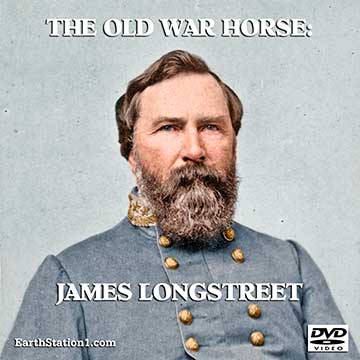
January 8, 1821: #BOTD: James Longstreet,
American general and diplomat, United States Ambassador to Turkey
(d. January 2, 1904) is #born in Edgefield District, South
Carolina. He was one of the foremost Confederate generals of the
American Civil War and the principal subordinate to General Robert
E. Lee, who called him his "Old War Horse". He served
under Lee as a corps commander for most of the battles fought by
The Army Of Northern Virginia in the Eastern Theater, and briefly
with Braxton Bragg in the Army of Tennessee in the Western
Theater. After graduating from the United States Military Academy
at West Point, Longstreet served in the United States Army during
the Mexican-American War. He was wounded in the thigh at the
Battle Of Chapultepec, and during recovery married his first wife,
Louise Garland. Throughout the 1850s, he served on frontier duty
in the American Southwest. In June 1861, Longstreet resigned his
U.S. Army commission and joined the Confederate Army. He commanded
Confederate troops during an early victory at Blackburn's Ford in
July and played a minor role at the First Battle Of Bull Run.
Longstreet made significant contributions to most major
Confederate victories, primarily in the Eastern Theater as one of
Robert E. Lee's chief subordinates in The Army Of Northern
Virginia. He performed poorly at Seven Pines by accidentally
marching his men down the wrong road, causing them to arrive late,
but played an important role in the Confederate success of the
Seven Days Battles in the summer of 1862, where he helped
supervise repeated attacks which drove the Union army away from
the Confederate capital of Richmond. Longstreet led a devastating
counterattack that routed the Union army at Second Bull Run in
August. His men held their ground in defensive roles at Antietam
and Fredericksburg. He did not participate in the Confederate
victory at Chancellorsville, as he and most of his soldiers had
been detached on the comparatively minor Siege of Suffolk.
Longstreet's most controversial service was at the Battle Of
Gettysburg in July 1863, where he openly disagreed with General
Lee on the tactics to be employed and reluctantly supervised
several unsuccessful attacks on Union forces. Afterward,
Longstreet was, at his own request, sent to the Western Theater to
fight under Braxton Bragg, where his troops launched a ferocious
assault on the Union lines at Chickamauga that carried the day.
Afterward, his performance in semi-autonomous command during the
Knoxville campaign resulted in a Confederate defeat. Longstreet's
tenure in the Western Theater was marred by his central role in
numerous conflicts amongst Confederate generals. Unhappy serving
under Bragg, Longstreet and his men were sent back to Lee. He ably
commanded troops during the Battle Of The Wilderness in 1864,
where he was seriously wounded by friendly fire. He later returned
to the field, serving under Lee in the Siege of Petersburg and the
Appomattox campaign. Longstreet enjoyed a successful post-war
career working for the U.S. government as a diplomat, civil
servant, and administrator. His support for the Republican Party
and his cooperation with his old friend, President Ulysses S.
Grant, as well as critical comments he wrote about Lee's wartime
performance, made him anathema to many of his former Confederate
colleagues. His reputation in the South further suffered when he
led African American militia against the anti-Reconstruction White
League at the Battle of Liberty Place in 1874. Authors of the Lost
Cause movement focused on Longstreet's actions at Gettysburg as a
principal reason for why the South lost the Civil War. As an
elderly man, he married Helen Dortch Longstreet, a woman several
decades younger than he was, who after his death worked to restore
her husband's image. James Longstreet died of pneumonia in
Gainesville, Georgia, six days before his 83rd birthday. Bishop
Benjamin Joseph Keiley, who had served under Longstreet, said his
funeral Mass. Longstreet's remains are buried in Alta Vista
Cemetery in Gainesville. He outlived most of his detractors and
was one of only a few general officers from the Civil War to live
into the 20th century. Since the late 20th century, Longstreet's
reputation has undergone a slow reassessment. Many Civil War
historians now consider him among the war's most gifted tactical
commanders. On Sale @ 15% Off Discount Till Midnight PT!
https://store.earthstation1.com/the-old-war-horse-james-longstreet-civil-war-mp4-video-download-dvd.html
Today's
EarthStation1.com 15% Off Commemorative Memorial Title: Long
Shadows: Civil War Legacy DVD, Video Download, USB Flash Drive
Today, January 8, 2026
January 8, 1867: The Reconstruction Era
(Reconstruction): Black Suffrage (Black Political Franchise, Black
Franchise, Black Right To Vote, Black Active Suffrage): -- The
United States Congress, dominated by radical Republicans, overrode
a January 5th veto by President Andrew Johnson and passes a bill
to allow all adult male citizens of the District of Columbia,
including African American men, the right to vote in Washington,
D.C.. It was the first law in U.S. history that extended the
ballot to African American men. Under the bill, every male citizen
of the nation's capital who was 21 or older became enfranchised.
The exceptions were welfare or charity cases, those under
guardianship, those convicted of major crimes and those who had
voluntarily sheltered Confederate troops or spies during the Civil
War. The Senate overrode Johnson's veto by a vote of 29-10, while
in the House the vote was 112-38. At the time, under a charter
granted by Congress in 1802, Washington voters had the right to
elect a local legislature, called a council, which could enact
laws and levy taxes on real estate to pay for city services. The
local government also included a mayor named by the president. The
new District law proved a precursor to nationwide enfranchisement
of African American men. In 1870, the United States ratified the
15th Amendment to the Constitution, prohibiting any state from
discriminating against potential male voters because of race or
previous condition of servitude. District residents have voted in
presidential elections since the passage of the 23rd Amendment in
1961, which first applied in the election of 1964. A nonvoting
delegate who may vote in committee and join in floor debates, but
who cannot vote on bills that come before the full House,
represents Washingtonians in the House. In 1978, Congress passed
the Voting Rights Amendment, giving the District full voting
representation in Congress. However, the amendment died in 1985,
after falling well short of adoption by the requisite 38 states.
On Sale @ 15% Off Discount Till Midnight PT!
https://store.earthstation1.com/long-shadows-dvd-legacy-of-the-american-civil-war.html
Today's
EarthStation1.com 15% Off Commemorative Memorial Title: The
Court-Martial Of George Armstrong Custer (1977) DVD, Download, USB
Today, January 8, 2026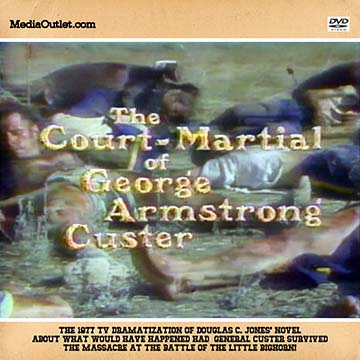
January 8, 1877: The American Indian Wars
(The American Frontier Wars, The Indian Wars): The Sioux Wars: The
Great Sioux War (The Black Hills War): The Battle Of Wolf
Mountain: (The Battle Of The Wolf Mountains, Miles's Battle On The
Tongue River, The Battle Of The Butte, Where Big Crow Walked Back
And Forth, The Battle Of Belly Butte) -- Chief Crazy Horse of the
Oglala Lakota Souix and his Lakota Sioux and Northern Cheyenne
warriors fight their last battle against the United States Cavalry
at Wolf Mountain in southern Montana Territory, about four miles
southwest of modern-day Birney, Montana, along the Tongue River.
The Battle Of Wolf Mountain is known by a number of names: The
Battle Of The Wolf Mountains, Miles's Battle On The Tongue River,
The Battle Of The Butte, Where Big Crow Walked Back And Forth, and
called The Battle Of Belly Butte by the Northern Cheyenne.
Following the defeat of Lieutenant Colonel George A. Custer on
June 25, 1876, in the Battle of Little Bighorn, the United States
government sent a large number of reinforcements into Montana
Territory. By autumn, a few bands of the Sioux and Cheyenne tribes
had begun returning to the reservations and agencies to acquire
food and annuity goods in preparation for winter. The United
States Congress had angered many Indians by demanding that they
cede the Black Hills to the government in exchange for these
promised goods. The army had replaced civilian contractors in
charge of the agencies, further convincing many war bands to stay
away from them. General Nelson Miles led a mixed force of
infantry, artillery and cavalry after Sitting Bull's band, and had
effectively defeated them by December. Ranald S. Mackenzie had
similarly defeated Dull Knife's Cheyennes, who trekked through
snow and icy conditions to join the camp of Crazy Horse in the
Tongue River Valley. Concerned with the approaching winter and the
destitute condition of Dull Knife's band, Crazy Horse decided to
negotiate peace with the army. However, when a group of United
States Army Crow scouts murdered Crazy Horse's delegation, the war
chief demanded revenge. He led a series of small raids in an
effort to draw out Colonel Miles from Tongue River Cantonment. In
December, 1876, Colonel Miles led most of nine Infantry companies
out of the Cantonment in pursuit of Crazy Horse, marching south,
up the Tongue River valley. On January 7, 1877, Miles captured a
few Northern Cheyennes, then his force of 436 men camped along the
Tongue just south of present-day Birney, Montana. During that
night a fresh layer of deep snow fell and temperatures dropped.
After shots were fired in the early morning hours, Miles set up a
defensive perimeter along a ridge line that's most prominent
feature was a small conical shaped knoll later called Battle
Butte, positioning two pieces of artillery beside it, in front of
a clear field of fire. At 7:00_a.m., Crazy Horse and Two Moon
began a series of attacks on the soldiers. Frustrated by army
firepower, the warriors regrouped several times to begin attacking
again. Attempts to flank Miles' line also proved to be futile when
Miles shifted his reserves to fill critical positions. Finally,
Miles ordered several 5th Infantry companies to advance to a
series of hills occupied by warriors. Miles' soldiers struggled in
taking the hills, the matter being further complicated with deep
snow. After soldiers secured seven of the hills the Sioux and
Cheyenne withdrew as weather conditions deteriorated, leaving the
field with a tactical draw. Although a draw in many aspects, in
effect the battle was a strategic victory for the U.S. Army, as it
demonstrated that the Sioux and Cheyenne were not safe from the
army even during the winter in harsh conditions. Many individuals
began slipping away and returning to their reservations. On May 6,
1877: Crazy Horse led his surviving band into Camp Robinson,
Nebraska to surrender to United States troops. In 2001, the Wolf
Mountains Battlefield was listed on the National Register of
Historic Places, and was raised to the status of National Historic
Landmark in 2008. On Sale @ 15% Off Discount Till Midnight PT!
https://store.earthstation1.com/the-courtmartial-of-george-armstrong-custer-dvd-brian-keith.html
Today's
EarthStation1.com 15% Off Commemorative Memorial Title: Evita
Peron (1981) With Faye Dunaway + Bonus Biography Download Or DVD
Today, January 8, 2026
January 8, 1912: #BOTD: #HBD! Jose
Ferrer, Puerto Rican-American actor and director (d. January 26,
1992) is #born Jose Vicente Ferrer de Otero y Cintron in San Juan,
Puerto Rico. He first achieved prominence for his portrayal of
Cyrano de Bergerac in the play of the same name, which earned him
the inaugural Tony Award for Best Actor in a Play in 1947. He
reprised the role in a 1950 film version and won an Academy Award,
making him the first Puerto Rican-born actor and the first
Hispanic actor to win an Oscar. His best-known film roles include
Henri de Toulouse-Lautrec in Moulin Rouge (1952), defense attorney
Barney Greenwald in The Caine Mutiny (1954), the Turkish Bey in
Lawrence of Arabia (1962), Siegfried Rieber in Ship of Fools
(1965), and Emperor Shaddam in Dune (1984). Ferrer also maintained
a prolific acting and directing career on Broadway, winning a
second Best Actor Tony for The Shrike, and Best Director for The
Shrike, The Fourposter, and Stalag 17. Ferrer was the father of
actor Miguel Ferrer by former wife Rosemary Clooney, the
grandfather of actress Tessa Ferrer, and the uncle of actor George
Clooney. His contributions to American theatre were recognized in
1981, when he was inducted into the American Theater Hall of Fame.
In 1985, he received the National Medal of Arts from President
Reagan, becoming the first actor so honored. Jose Ferrer died of
colorectal cancer in Coral Gables, Florida 18 days after his 80th
birthday, and is interred in Santa Maria Magdalena de Pazzis
Cemetery in Old San Juan in his native Puerto Rico. On Sale @ 15%
Off Discount Till Midnight PT!
https://store.earthstation1.com/evita-peron-1981-tv-miniseries-faye-dunaway-mp4-video-downloa19814.html
Today's
EarthStation1.com 15% Off Commemorative Memorial Title: Classic
Baby Boomer Bloopers Video Collection DVD, Download, USB Drive
Today, January 8, 2026
January 8, 1923: #BOTD: #HBD! Larry
Storch, American actor and comedian known for his comic television
roles, including voice-over work for cartoon shows such as Mr.
Whoopee on Tennessee Tuxedo and His Tale, best known as the
bumbling Corporal Randolph Agarn on F Troop for which he was
nominated for an Emmy Award in 1967 (d. July 8, 2022) is #born
Lawrence Samuel Storch in New York City, the son of observant Jews
Alfred Storch, a cabdriver and broker, and his wife, Sally
Kupperman Storch, a telephone operator, jewelry-store owner and
rooming-house operator. The Washington Post reported that he was
born in the Bronx, whereas The New York Times reported that he was
born in Manhattan and The Wall Street Journal reported that he was
born on the Upper West Side. He attended DeWitt Clinton High
School in the Bronx with Don Adams, who remained his lifelong
friend. Storch said that, because of hard times in the Great
Depression, he never graduated from high school, instead finding
work as a comic for 12 USD a week, opening for bandleader Al
Donahue at the band shell in Sheepshead Bay. During World War II,
he served in the United States Navy, where he was shipmates with
Tony Curtis on the submarine tender USS Proteus (AS-19). Storch
was originally a comic. It led to guest appearances on dozens of
television series: Mannix; Car 54, Where Are You?; Hennesey; Get
Smart; Sergeant Bilko; Columbo; CHiPs; Fantasy Island; McCloud;
Emergency!; The Flying Nun; Alias Smith and Jones; The Alfred
Hitchcock Hour; That Girl; I Dream of Jeannie; Gomer Pyle,
U.S.M.C.; Gilligan's Island; The Doris Day Show; The Persuaders;
Love, American Style; All in the Family; Kolchak: The Night
Stalker and Married... with Children. His most famous role was
from 1965 to 1967 as the scheming Corporal Randolph Agarn on the
situation comedy F Troop, with Forrest Tucker, Ken Berry and
Melody Patterson, for which he was nominated for an Emmy Award in
1967. Other memorable performances from the 1960s were Texas Jack
in the barroom brawl scene of The Great Race and the eponymous
character in the Groovy Guru episode of Get Smart. In 1975, Storch
co-starred with Bob Burns (who wore a gorilla costume) and Forrest
Tucker on the short-lived but popular Saturday morning children's
show The Ghost Busters. He also appeared on The Love Boat, S1 E15
& S2 E9 (1978); was Al Bundy's childhood hero on Married...
with Children (Al Bundy's daughter Kelly attended an acting school
operated by Larry); and was a semi-regular on Car 54, Where Are
You?. He co-starred on the short-lived series The Queen and I.
Storch appeared on many variety shows, including Sonny and Cher,
Laugh-In, Hollywood Squares, Playboy After Dark, and The Hollywood
Palace, with several appearances on The Ed Sullivan Show, The
Tonight Show Starring Johnny Carson, and The Steve Allen Show.
Jackie Gleason asked Storch to fill in for him in the summer of
1953 while Gleason was on hiatus. It led to the 10-episode The
Larry Storch Show with guest stars including Janet Blair, Rise
Stevens, Dick Haymes, and Cab Calloway. An impressionist, Storch
recreated hundreds of voices and dialects ranging from Muhammad
Ali to Claude Rains and voiced characters in many television and
film animations, including The Pink Panther Show, Groovie Goolies,
The Inspector, The Brady Kids, Cool Cat, Koko the Clown, Treasure
Island, and Tennessee Tuxedo. Storch worked with Mel Blanc and
June Foray at Warner Bros.-Seven Arts, voicing characters such as
Merlin the Magic Mouse and Cool Cat. He continued his association
with Filmation as a voiceover actor in other series and films the
company produced, including Journey Back to Oz (1972) where he
voiced Amos, farmhand to Aunt Em and Uncle Henry. Storch appeared
in more than 25 Hollywood films, including Gun Fever (1958), Who
Was That Lady? (1960), 40 Pounds of Trouble (1962), Captain
Newman, M.D. (1963), Wild and Wonderful (1964), Sex and the Single
Girl (1964), and The Great Race (1965). He also appeared in Bus
Riley's Back in Town (1965), A Very Special Favor (1965), That
Funny Feeling, (1965), The Great Bank Robbery (1969), Airport 1975
(1974), The Happy Hooker Goes to Washington (1977), Record City
(1978), S.O.B (1981), Fake-Out (1982), Sweet Sixteen (1983), and A
Fine Mess (1986), as well as the cult sci-fi films The Monitors
(1969) and Without Warning (1980). Tony Curtis and Storch reunited
for a 2003 run of the musical version of Some Like It Hot. In
2005, he worked with Anthony Michael Hall in Funny Valentine and
appeared in the documentary feature The Aristocrats. After success
in television and films, Storch returned to the New York stage,
having first performed on the Broadway stage in the 1950s. He
received rave reviews for the Off-Broadway production of Breaking
Legs. Co-starring Philip Bosco and Vincent Gardenia, the show
extended several times before going on the road. Storch appeared
in the Broadway productions of Porgy and Bess (which Storch
considered his favorite), Arsenic and Old Lace with Jean
Stapleton, Marion Ross, and Jonathan Frid, and Annie Get Your Gun
with Reba McEntire. He toured the United States and Europe with
Porgy and Bess. In 2004, he was in Sly Fox with Richard Dreyfuss
and his old friend Irwin Corey. Larry, then 81 and "Professor"
Corey, 90, did eight shows a week. In March 2008, Storch
celebrated his 50th anniversary performing on Broadway. His first
Broadway appearance had been Who Was That Lady I Saw You With,
later made into a 1960 film starring Dean Martin and Tony Curtis,
with Storch appearing. Storch and Dark Shadows star Marie Wallace
appeared in Love Letters by A. R. Gurney on June 24, 2012, a
benefit performance for the Actor's Temple in New York City. In
the summer of 2012, Storch appeared in a benefit performance of
Love Letters with actress Diana Sowle (best known for her role as
Mrs. Bucket in the original Willy Wonka film) in Farmville,
Virginia to benefit The Tom Mix Rangers. Storch recorded a comedy
LP, Larry Storch at The Bon Soir, released by Jubilee Records in
the 1960s. His other records include Larry Storch Reads Philip
Roth's Epstein and singles such as "Pooped" b/w "The
Eighth Wonder Of The World" and a spoken-word cover of Fats
Domino's "I'm Walkin'". Storch married actress Norma
Catherine Greve on July 10, 1961. They remained married until her
death at age 81 on August 28, 2003. Both briefly appeared in the
made-for-television movie The Woman Hunter (1972). He had three
children: a stepson, Lary May; a daughter, Candace Herman, the
result of a brief encounter with his future wife, born in 1947 and
placed for adoption (and later reunited); and a stepdaughter, June
Cross, a distinguished television producer, documentary film
director and journalism professor, born in 1954 to Norma and
African American Jimmy Cross ("Stump" of the
song-and-dance team Stump and Stumpy). At the age of four, when
June could no longer "pass" as "looking white,"
she was sent to live with her mother's black friends, Peggy and
Paul Bush, in Atlantic City, New Jersey. Cross spent her holidays
and summers visiting with her mother in New York and later in
California, after she married Larry Storch, well-known actor of a
number of 1960's sitcoms. Given the racial tensions of the time
and the Hollywood spotlight of Norma Storch's world, June Cross
would always be introduced as a niece or an adopted child.
Storch's younger brother, Jay (1924-1987), was an actor/voiceover
performer under the name Jay Lawrence. Storch was nominated for a
Primetime Emmy Award in 1967 for Outstanding Continued Performance
by an Actor in a Leading Role in a Comedy Series for F Troop.
Storch lost to childhood friend Don Adams that year. Storch said
he later remarked to Adams, "You kept it on the block."
An episode of Animaniacs titled "The Sound of Warners"
features a banner that says "Larry Storch Days / Nov 13 &
14". In Fort Lee, New Jersey, Mayor Mark Sokolich named
Storch as honorary Mayor for a Day on June 1, 2014. Storch had
previously been honored by the local film commission for
performing at the Riviera nightclub, which had closed 60 years
earlier. He received the 2013 Barrymore Award for Lifetime
Achievement in Film and TV from the Fort Lee Film Commission. A
Golden Palm Star on the Palm Springs, California, Walk of Stars
was dedicated to Storch in 2014. Storch was named an honorary
citizen of Passaic, New Jersey, on September 13, 2016. He also
received a Navy Distinguished Service Medal to recognise his World
War II service. On January 14, 2019, The Lambs honored Storch with
their Shepherd's Award. Wild West City, an amusement park in New
Jersey, renamed one of its storefronts "Larry Storch's Silver
Dollar Saloon" in his honor. Storch was named an Honorary
Friar in early 2019 at a ceremony with Dick Cavett at the New York
Friars Club. On his 97th birthday, Storch was presented with a
Proclamation from the State of New York. Larry Storch died at his
home on the Upper West Side of Manhattan at age 99. The Associated
Press reported that he died from natural causes. The Washington
Post reported that he died from complications of Alzheimer's
disease. His remains were cremated, and his remains were given to
unspecifed family members. A month before he died, Storch recorded
the blues song Drinkin' Wine Spo-Dee-O-Dee with Mike Clark and his
trio. The song was posthumously released soon after Storch's
passing. On Sale @ 15% Off Discount Till Midnight PT!
https://store.earthstation1.com/classic-baby-boomer-bloopers-tv-amp-movie-blooper-outtakes-dvd.html
Today's
EarthStation1.com 15% Off Commemorative Memorial Title: Birds Do
It (1966) Soupy Sales Movie DVD, Video Download, USB Drive
Today, January 8, 2026
January 8, 1926: #BOTD: #HBD! Soupy
Sales, American comedian, actor, radio/television personality and
jazz aficionado (d. October 22, 2009) is #born Milton Supman in
Franklinton, North Carolina. He was best known for his local and
network children's television show, Lunch with Soupy Sales
(1953-1966), a series of comedy sketches frequently ending with
Sales receiving a pie in the face, which became his trademark. He
also starred in the 1966 movie Birds Do It. From 1968 to 1975, he
was a regular panelist on the syndicated revival of What's My
Line? and appeared on several other TV game shows. During the
1980s, Sales hosted his own show on WNBC-AM in New York City.
Soupy Sales died at Calvary Hospice in Bronx, New York, aged 83,
from cancer. He is buried at Kensico Cemetery in Valhalla, New
York. On Sale @ 15% Off Discount Till Midnight PT!
https://store.earthstation1.com/birds-do-it-dvd-soupy-sales-movie.html
Today's
EarthStation1.com 15% Off Commemorative Memorial Title: The
Complete Kennedy-Nixon Debates All 4 + Bonus Doc DVD MP4 USB Drive
Today, January 8, 2026
January 8, 1928: #BOTD: #HBD! Sander
Vanocur, American television journalist who focused on U.S.
national electoral politics (d. September 16, 2019) is #born
Alexander Vinocur in Cleveland, Ohio, the son of Rose (Millman)
and Louis Vinocur, a lawyer. His family was of Russian Jewish
descent. Sander "Sandy" Vanocur moved to Peoria,
Illinois when he was twelve years old. After attending Western
Military Academy in Alton, Illinois, he earned a bachelor's degree
in political science from the Northwestern University School of
Speech (1950) and studied at the London School of Economics
(1951-52). After serving for two years in the U.S. Army, he began
his journalism career as a reporter on the London staff of The
Manchester Guardian and also did general reporting for The New
York Times. Described as "one of the country's most prominent
political reporters during the 1960s," Vanocur served as
White House correspondent and national political correspondent for
NBC News in the 1960s and early 1970s. He was one of the
questioners at the first of the Kennedy-Nixon debates in 1960. He
was also chosen as one of the questioners in the 1992 presidential
debate, as well as one of NBC's "four horsemen," its
floor reporters at the political conventions in the 1960s-the
other three were John Chancellor, Frank McGee, and Edwin Newman.
While White House correspondent during the Kennedy administration,
Vanocur was one of the first reporters to publicly ask Kennedy to
justify the failure of the Bay Of Pigs Invasion. Vanocur also
dubbed Kennedy's coterie the "Irish mafia." Later,
Vanocur covered the 1968 United States presidential election in
which United States Robert F. Kennedy was assassinated. Vanocur,
who had interviewed Kennedy on June 4, 1968, shortly before the
Democratic candidate was shot, reported on the incident from The
Ambassador Hotel in Los Angeles, California, for the entire night.
Kennedy died the following day at Good Samaritan Hospital. On the
final night of the 1968 Republican National Convention in Miami
Beach, during a convention-wrapping Thursday night round-table
discussion with his fellow NBC floor reporters in the vacated
folding chairs on the convention hall floor, Vanocur suggested
that the Republicans had "kissed off the black vote" in
1968, a comment which caused a media uproar in the ensuing week.
Vanocur also served as host of First Tuesday, a monthly
newsmagazine that premiered in 1969 and continued after Vanocur
left the network. His work at NBC earned him a place on the Nixon
administration's "enemies list". After leaving NBC in
1971, Vanocur worked for PBS and as a television writer for The
Washington Post. He joined ABC News in 1977 and worked there until
1991, holding various positions, including Chief Diplomatic
Correspondent, Senior Correspondent in Buenos Aires, and anchor
for Business World, the first regularly scheduled weekly business
program. He covered the 1997, 1998, and 1999 World Economic
Summits and was Chief Overview Correspondent during the 1980 and
1984 presidential elections. In 1984, Vanocur moderated the Vice
Presidential debate between incumbent George H. W. Bush and
Congresswoman Geraldine Ferraro. He made a cameo appearance as
himself in the movie Dave and was one of the major performers,
again playing himself, in the sci-fi television special Without
Warning as one of the main news anchors linking the various scenes
together. Vanocur hosted two of the History Channel's primetime
series: Movies in Time and History's Business. Vanocur married his
first wife, fashion designer Edith Pick, on March 3, 1956, and
they had two sons, Nicholas and Christopher Vanocur. Christopher
is a television news reporter and a former news anchor in Salt
Lake City television market. After Edith's death in April, 1975,
Vanocur married Virginia Backus Wood on December 19, 1975. The
1971 comedy film Cold Turkey depicts a national news anchor whose
name is "Sandy Van Andy." On Sale @ 15% Off Discount
Till Midnight PT!
https://store.earthstation1.com/the-great-kennedynixon-debate-dvd.html
Today's
EarthStation1.com 15% Off Commemorative Memorial Title: The Trial
Of Lee Harvey Oswald TV Special Series DVD, Download, USB
Today, January 8, 2026
January 8, 1929: #BOTD: #HBD! Gerry
Spence, semi-retired American trial lawyer and author considered
one of the greatest lawyers of the 20th century and one of the
best trial lawyers of all time, who never lost a criminal case
before a jury either as a prosecutor or a defense attorney, and
did not lose a civil case between 1969 and 2010, member of the
Trial Lawyer Hall of Fame, founder of the Trial Lawyers College,
is #born Gerald Leonard Spence in Laramie, Wyoming. Spence is
recognized for winning virtually every case he has dealt with, and
for winning a number of well-known cases, such as Randy Weaver at
Ruby Ridge, the Ed Cantrell murder case, the Karen Silkwood case,
and the defense of Geoffrey Fieger. He also defended Brandon
Mayfield, and carried out the successful prosecution of Mark
Hopkinson as a special prosecutor. One of his most significant
cases was the defense of Imelda Marcos, former First Lady of the
Philippines and first governor of Metro Manila, in a
racketeering/fraud case considered one of the trials of the
century, which he won. He has also won large compensastion
lawsuits against companies, such as 26.5M USD in libel damages for
1978 Miss Wyoming Kim Pring against Penthouse in 1981. He also won
a$52M USD lawsuit against McDonald's in 1984. According to Spence,
he has won more such large compensation verdicts without an
intervening loss than any lawyer in America. He acted as a legal
consultant for NBC in its coverage of the O.J. Simpson trial and
appeared on Larry King Live. He is the author of over a dozen
books about politics and law, including The New York Times
bestseller How To Argue And Win Every Time (1995), Win Your Case
(2005), From Freedom To Slavery (1993), and Police State: How
America's Cops Get Away with Murder (2015). On Sale @ 15% Off
Discount Till Midnight PT!
https://store.earthstation1.com/the-trial-of-lee-harvey-oswald-dvd-set-3-disc3.html
Today's
EarthStation1.com 15% Off Commemorative Memorial Title: San
Francisco Good Times: Counterculture Newspaper MP4 Download Or DVD
Today, January 8, 2026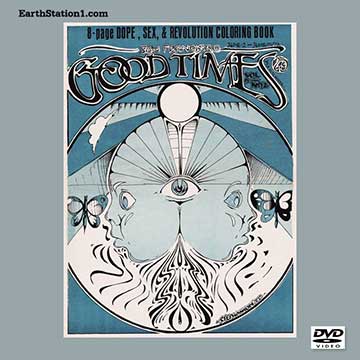
January 8, 1931: #BOTD: #HBD! Bill
Graham, German-American impresario and rock concert promoter from
the 1960s until his death in 1991 in a helicopter crash (d.
October 25, 1991) is #born Wulf Wolodia Grajonca in Berlin, the
youngest child and only son of Jewish lower middle-class parents.
Graham had a profound influence around the world, sponsoring the
musical renaissance of the 1960s from its epicenter in San
Francisco. Chet Helms and then Graham made famous the Fillmore and
Winterland Ballroom; these turned out to be a proving grounds for
rock bands and acts of the San Francisco Bay area including the
Grateful Dead, Jefferson Airplane, and Big Brother and the Holding
Company with Janis Joplin, who were first managed, and in some
cases developed, by Helms. Graham's father Jacob died accidentally
two days after his son's birth; due to the increasing peril to
Jews in Germany, and because of the death of Jacob, Graham's
mother placed her son, nicknamed"Wolfgang", and her
youngest daughter, Tanya "Tolla", in a Berlin orphanage,
which sent them to France in a pre-Holocaust exchange of Jewish
children for Christian orphans. Graham's older sisters Sonja and
Ester stayed behind with their mother. After the fall of France,
Graham was among a group of Jewish orphans spirited out of France,
some of whom finally reached the United States. Tolla Grajonca
came down with pneumonia and did not survive the difficult
journey. Graham was one of the One Thousand Children (OTC), mainly
Jewish children who managed to flee Hitler and Europe and come
directly to North America, but whose parents were forced to stay
behind. Graham's mother died in Auschwitz. On July 4, 1939, he was
sent from Germany to France due to political uncertainty in his
home country. At age 10, he settled into a foster home in the
Bronx, New York. Graham graduated from DeWitt Clinton High School.
After being taunted there as an immigrant, and after being called
a Nazi because of his German-accented English, Graham worked on
his accent, eventually being able to speak in a perfect New York
accent. He changed his name to sound more "American"; he
found the name "Graham" in the phone book, and decided
to call himself by that last name as it was the closest he could
find to his birth surname, "Grajonca". He subsequently
from City College with a business degree from the City College of
New York; he was later quoted as describing his training there as
that of an "efficiency expert". Graham was drafted into
the United States Army in 1951, and served in the Korean War,
where he was awarded both the Bronze Star and Purple Heart. Upon
his return to the States he worked as a waiter/maitre d' in the
Catskill Mountain resorts in upstate New York known as "The
Borscht Belt" during their heyday. He was quoted saying that
his experience as a maitre d' and with the poker games he hosted
behind the scenes was good training for his eventual career as a
promoter. Tito Puente, who played some of these resorts, went on
record saying that Graham was avid to learn Spanish from him, but
only cared about the curse words. He also mentions in his bio-pic
Last Days At The Fillmore that he worked for the Minnesota Mining
company. Graham moved from New York to San Francisco in the early
1960s to be closer to his sister Rita. He was invited to attend a
free concert in Golden Gate Park, produced by local Haight Ashbury
promoter Chet Helms, and by The Diggers, a radical
community-action group of activists and Street Theatre actors
operating from 1966 to 1968, who Capitol Records promoter Derek
Taylor (who represented rival bands The Beatles and The Beach Boys
simultaneously) called "the best people in the world to have
a row with". Through Helms and The Diggers, Graham made
contact with the San Francisco Mime Troupe, a radical theater
group. After Mime Troupe leader R. G. Davis was arrested on
obscenity charges during an outdoor performance, Graham organized
a benefit concert to cover the troupe's legal fees. The concert
was a success and Graham saw a business opportunity. Graham began
promoting more concerts with Chet Helms and Family Dog projects,
which provided a vital function of the 1960s, promoting concerts
that provided a social meeting place to network, where many
ideologies were given a forum, sometimes even on stage, such as
peace movements, civil rights, farm workers and others. Most of
his shows were performed at rented venues, and Graham saw a need
for more permanent locations of his own. Charles Sullivan was a
mid-20th-century entrepreneur and businessman in San Francisco who
owned the master lease on the Fillmore Auditorium. Graham
approached Sullivan to put on the Second Mime Troupe appeals
concert at the Fillmore Auditorium on December 10, 1965, using
Sullivan's dance hall permit for the show. Graham later secured a
contract from Sullivan for the open dates at the Fillmore
Auditorium in 1966. Graham credits Sullivan with giving him his
break in the music concert hall business. These events ultimately
turned into a profitable full-time career for Graham, and he
assembled a talented staff. Graham had long dreamed of being a
character actor. He appeared in Apocalypse Now in a small role as
a promoter. In 1990, he was cast as Charles "Lucky"
Luciano in the film Bugsy. During one scene, he is shown in a
Latin dance number, a style of dancing Graham had embraced as a
teenager in New York. He also appears as a promoter in the 1991
Oliver Stone film The Doors, which he also co-produced. He had a
small part in Gardens of Stone as Don Brubaker, a hippie anti-war
protester. Bill Graham died when he was killed in a helicopter
crash west of Vallejo, California, aged_60, while returning home
from a Huey Lewis and the News concert at the Concord Pavilion.
Graham had attended the event to discuss promoting a benefit
concert for the victims of the 1991 Oakland Hills Firestorm. Once
he had obtained a commitment from Huey Lewis to perform, he
returned to his helicopter. Flying in severe weather, with rain
and gusty winds, the aircraft flew off course and too low over the
tidal marshland north of San Pablo Bay. The Bell Jet Ranger flew
directly into a 223-foot (68-meter) high-voltage tower near where
Highway 37, which runs between Vallejo, California, and Marin
County, California, crosses Sonoma Creek. The helicopter burst
into flames on impact, killing Graham, pilot and advance man Steve
"Killer" Kahn, and Graham's girlfriend, Melissa Gold
(nee Dilworth), ex-wife of author Herbert Gold. The charred
remains of the helicopter hung in the tower for more than a day.
B.B. King credits Graham with reviving his career when he was
booked by Graham into the Fillmore East. King said that prior to
this, he was, like all other blues artists, "catchin' hell",
and only playing for small black audiences; but that at that
concert, where Graham introduced him as "The King Of The
Blues", and all others concerts afterward, he played to large
audiences, with more white faces that black, and that for the
first time in his life, he made good money. On Sale @ 15% Off
Discount Till Midnight PT!
https://store.earthstation1.com/san-francisco-good-times-dvd-underground-newspaper.html
Today's
EarthStation1.com 15% Off Commemorative Memorial Title: Dwight
David Eisenhower: A Decent Man LP Record CD, MP3 Download, USB
Today, January 8, 2026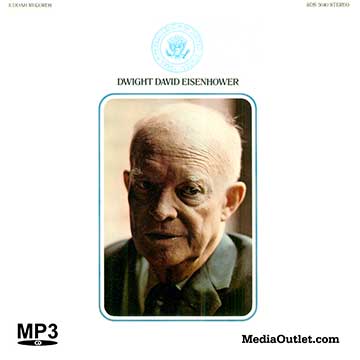
January 8, 1933: #BOTD: #HBD! Charles
Osgood, American radio and television commentator, writer, and
musician, best known both for being the host of CBS News Sunday
Morning, a role he held for over 22 years from April 10, 1994,
until September 25, 2016, and The Osgood File, a series of daily
radio commentaries he hosted from 1971 until December 29, 2017,
co-composer of Senator Everett Dirksen's Grammy Award winning
spoken record song "Gallant Men" (d. January 23, 2024)
is #born Charles Osgood Wood III in Manhattan, New York City.
Osgood was also known for being the narrator of Horton Hears a
Who!, an animated film released in 2008, based on the book of the
same name by Dr. Seuss. He published a memoir of his boyhood in
2004. As a child, he moved with his family to the Liberty Heights
neighborhood of Baltimore, Maryland. He attended St. Cecilia High
School in Englewood, New Jersey. His memoir about growing up in
Baltimore during World War II is called Defending Baltimore
Against Enemy Attack (2004) and in it he recounts his perspective
from age nine. Osgood graduated from Fordham University in 1954
with a Bachelor of Science degree in economics. While attending
Fordham, Osgood volunteered at the university's FM campus radio
station, WFUV. He often played piano between records on his shows
and frequently collaborated with other students, including future
actor Alan Alda and future producer and director Jack Haley, Jr.
Immediately after graduating from Fordham University, Osgood was
hired as an announcer by WGMS (AM) and WGMS-FM, the classical
music stations in Washington, D.C. (today WWRC and WTOP-FM
respectively). Shortly afterward, however, he enlisted in the
military to be the announcer for the United States Army Band. In
1991, he explained this turn of events in an interview with the
Los Angeles Times. He remarked "[After college graduation] I
went right to work for a classical musical [sic] station in
Washington called WGMS. I was an announcer. I learned a lot doing
that. I was about to be drafted in the Army, this was 1954, and I
ran into a guy while I was having dinner with a friend of mine and
he was dressed in a white uniform, the most fancy uniform this
side of the Ritz Hotel. It turned out he was the announcer for the
United States Army Band. I asked him when he was getting out and
he said within the next few weeks, so the next morning I was
parked out at the commanding officer's office. He was impressed
with the fact I could pronounce Rimsky-Korsakov. That's how I got
the job. I spent three years with the United States Army Band. It
was a great experience." Besides acting as the band's master
of ceremonies, he performed as a pianist with the band and sang
with the United States Army Band|United States Army Chorus. His
roommate, John Cacavas, composed arrangements for the band. They
would collaborate on many songs, a relationship that would
continue through the 1960s. In 1967, along with U.S. Senator
Everett Dirksen (R- Illinois), they shared a Grammy Award for best
spoken word performance for their single Gallant Men. As Dirksen
read a patriotic poem written by H. Paul Jeffers about the dignity
of duty in the armed forces, it was framed by Cacavas and Osgood's
martial music and stirring choral refrains. In 1967 it peaked at
number 16 on the Billboard 200 record chart. Stationed adjacent to
Arlington National Cemetery at Fort Myer during his service with
the U.S. Army Band, using pseudonyms, Osgood worked as an
announcer for radio stations in the Washington area to supplement
his income and experience. He hosted the morning show on WEAM
(WZHF today) as "Charlie Woods." At WGMS, he called
himself "Carl Walden." At WPGC (AM) (WJFK (AM) today), a
rock station, he referred to himself as "Chuck Forest."
In September 1955, President Dwight D. Eisenhower suffered a
serious heart attack during a vacation in Denver, Colorado, and
was confined to a hospital room there until November. During this
time, under the auspices of WGMS, Osgood hosted a closed-circuit
program of classical music delivered exclusively to the
president's room to encourage his relaxation and convalescence.
When his tour with the U.S. Army Band was completed, in October
1957, Osgood returned to WGMS full-time as announcer Charles Wood
and as a special assistant to the general manager. Before the end
of 1958, WGMS promoted him to program director. In 1960, credited
by name and as a WGMS announcer, he provided introductions and
commentary on a six-record album of a collection of thirty-three
speeches by President Franklin Delano Roosevelt titled FDR Speaks.
Edited by historian Henry Steele Commager, it included a welcome
by the president's widow, former first lady Eleanor Roosevelt.
Their son Franklin Delano Roosevelt, Jr. recited one of his
father's speeches. Billboard magazine reported that FDR Speaks
"was one of the most listened-to-attractions" at the
1960 Democratic National Convention which nominated senators John
F. Kennedy and Lyndon B. Johnson as its candidates for President
and Vice President of the United States. In April 1962, the parent
company of WGMS, RKO General, transferred Osgood to Hartford,
Connecticut, and promoted him to his first job in television: the
general manager of Channel 18, WHCT (WUVN today). WHCT was the
first TV station in the United States to be licensed to use
Phonevision, a system developed by Zenith that scrambled the
station's picture and sound. This limited viewing to paid
subscribers who were issued decoders attached to their television
sets and telephone lines. The station offered its subscribers
premium programming such as first-run movies, live sporting
events, and cultural programs like ballets and symphonies, all
with no commercials. Although RKO expected to operate WHCT at a
loss for the three years before the Federal Communications
Commission was due to renew the station's license, by early 1963,
the financial realities became too difficult to bear unabated. In
a 1985 interview with Broadcasting magazine, Osgood explained
"[The station] lost money at an alarming rate ... [RKO] let
me off the hook very gently. They said, "you're fired."
Unemployed at age 30, Osgood turned to one of his Fordham
classmates, Frank McGuire, who directed program development at ABC
in New York. In 1963, McGuire hired Osgood to be one of the
writers and hosts of Flair Reports, which related human interest
stories on the ABC Radio Network. "I went from being the
world's youngest station manager to being the world's oldest cub
reporter", he quipped in a 1981 interview with People
magazine. Another new McGuire hire for Flair Reports, whom Osgood
befriended at ABC, was Ted Koppel. While he was at ABC, he began
using the name "Charles Osgood" because the network
already had an announcer named "Charles Woods". In a
2005 interview with Inside Radio, Osgood related the story: "They
didn't want to have a Charles Woods and a Charles Wood. When they
told me to pick a name, I used my middle name as my last name.
It's worked out well and is a little more distinctive and
professional. Osgood moved over to CBS Radio in 1967 when it
became clear, in his words, that he "wasn't going anywhere"
at ABC. He worked as a reporter and anchor for WCBS. In August
1967, he anchored the first morning drive shift for WCBS after its
conversion to an all-news format. The first day of all-news
programming aired on WCBS-FM after an airplane crashed into the AM
station's antenna tower on New York's High Island, keeping WCBS
off air until a temporary tower could be erected. Osgood anchored
The Osgood File on of Westwood One, a daily commentary morning
show. It began as a segment on WCBS in 1967 and went national in
1971. Each three-minute Osgood File focused on a single story,
ranging from a breaking development of national importance to a
whimsical human-interest vignette. Some of those he did in rhyme,
which is why he was known as CBS's "Poet in Residence."
He continued these broadcasts until December 29, 2017. On
television, Osgood joined CBS News in 1971. He was a reporter, and
served as anchor of the CBS Sunday Night News from 1981 to 1987,
co-anchor of the weekday CBS Morning News and frequent news reader
on CBS This Morning from 1987 to 1992, as well as occasional
anchor of the CBS Afternoon News and the CBS Evening News with Dan
Rather. Osgood hosted CBS News Sunday Morning from April 10, 1994,
to September 25, 2016, succeeding the original host Charles
Kuralt. Osgood's tenure of twenty-two years as host exceeded
Kuralt's fifteen years. Among Osgood's personal trademarks were
his bow tie, his weekly TV signoff "Until then, I'll see you
on the radio", and his propensity for delivering his
commentaries in whimsical verse. Example: When the Census Bureau
invented a designation for cohabitant(s) as "Person(s) of
Opposite Sex Sharing Living Quarters", or "POSSLQ",
Osgood turned it into a pronounceable three-syllable word and
composed a prospective love poem that included these lines, which
he later used as the title of one of his books, "There's
nothing that I wouldn't do | If you would be my POSSLQ". On
December 21, 2017, it was announced Osgood would retire from The
Osgood File due to health concerns, ending his broadcast career.
His final broadcasts were on December 29, 2017. Osgood's first
marriage to Theresa Audette ended in divorce after 16 years. He
and his second wife, Jeanne Crafton, had five children, who were
raised in Englewood, New Jersey. When they became empty nesters,
Osgood and his wife moved to a 12-room duplex on West 57th Street
at 7th Avenue in New York City. Osgood died from complications of
dementia at his home in Saddle River, New Jersey at age 91. His
remains were cremated in a private ceremony, and the ashes
retained by his widow Jean Crafton. CBS News Sunday Morning
dedicated its full January 28, 2024, broadcast to celebrating
Osgood's life and work. On Sale @ 15% Off Discount Till Midnight
PT!
https://store.earthstation1.com/dwight-david-eisenhower-a-decent-man-lp-album-mp3-c3.html
Today's
EarthStation1.com 15% Off Commemorative Memorial Title: Elvis
Presley Documentaries Set MP4 Video Download DVD
Today, January 8, 2026
January 8, 1935: #BOTD: #HBD! Elvis
Presley, American singer, guitarist and actor, nicknamed "The
King Of Rock And Roll" and "The King", regarded as
one of the most significant cultural icons of the 20th century (d.
August 16, 1977) is #born Elvis Aaron Presley in Tupelo,
Mississippi. Presley was born in Tupelo, Mississippi, and
relocated to Memphis, Tennessee, with his family when he was 13
years old. His music career began there in 1954, recording at Sun
Records with producer Sam Phillips, who wanted to bring the sound
of African American music to a wider audience. Accompanied by
guitarist Scotty Moore and bassist Bill Black, Presley was a
pioneer of rockabilly, an uptempo, backbeat-driven fusion of
country music and rhythm and blues. In 1955, drummer D. J. Fontana
joined to complete the lineup of Presley's classic quartet and RCA
Victor acquired his contract in a deal arranged by Colonel Tom
Parker, who would manage the singer for more than two decades.
Presley's first RCA single, "Heartbreak Hotel", was
released in January 1956 and became a number one hit in the United
States. With a series of successful network television appearances
and chart-topping records, he became the leading figure of the
newly popular sound of rock and roll. His energized
interpretations of songs and sexually provocative performance
style, combined with a singularly potent mix of influences across
color lines during a transformative era in race relations, made
him enormously popular-and controversial. In November 1956,
Presley made his film debut in Love Me Tender. Drafted into
military service in 1958, Presley relaunched his recording career
two years later with some of his most commercially successful
work. He held few concerts however, and guided by Parker,
proceeded to devote much of the 1960s to making Hollywood movies
and soundtrack albums, most of them critically derided. In 1968,
following a seven-year break from live performances, he returned
to the stage in the acclaimed television comeback special Elvis,
which led to an extended Las Vegas concert residency and a string
of highly profitable tours. In 1973, Presley gave the first
concert by a solo artist to be broadcast around the world, Aloha
from Hawaii. Years of prescription drug abuse severely compromised
his health, and he died suddenly at his Graceland estate of
cardiac arrest and pronounced dead at the Memphis Baptist Hospital
at 3:30 p.m., aged 42. He was originally buried next to his mother
at Forest Hill Cemetery in Memphis, Tennessee, but after an
attempt to steal Presley's coffin, both their bodies were moved to
Graceland, where they were buried in the Meditation Garden, where
eventually his daughter Lisa Marie, who inherited the estate, and
her son, Benjamin Keough. Presley is one of the most celebrated
and influential musicians of the 20th century. Commercially
successful in many genres, including pop, country, blues, and
gospel, he is the best-selling solo artist in the history of
recorded music. He won three competitive Grammys, received the
Grammy Lifetime Achievement Award at age 36, and has been inducted
into multiple music halls of fame. On Sale @ 15% Off Discount Till
Midnight PT!
https://store.earthstation1.com/viva-elvis-dvd-elvis-presley-cult-documentary.html
Today's
EarthStation1.com 15% Off Commemorative Memorial Title: WABC Radio
Airchecks MP3 Collection 1960s-1980s DVD, MP3 Download, USB
Today, January 8, 2026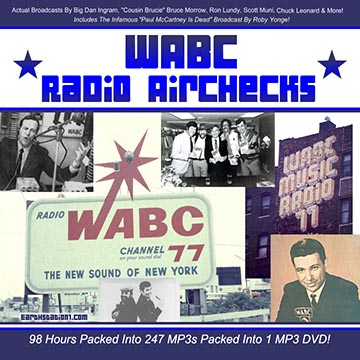
January 8, 1937: #BOTD: #HBD! Shirley
Bassey, Welsh African singer widely regarded as one of the most
popular vocalists in Britain, best known for her career longevity,
powerful voice and recording the theme songs to three James Bond
films: Goldfinger (1964), Diamonds Are Forever (1971), and
Moonraker (1979), is #born Shirley Veronica Bassey was born on
Bute Street in Tiger Bay, Cardiff, Wales, the sixth and youngest
child of Nigerian father Henry Bassey and English mother Eliza
Jane Start. Dame Shirley Veronica Bassey DBE began performing as a
teenager in 1953. In 1959, she became the first Welsh person to
gain a number-one single on the UK Singles Chart. In the following
decades, Bassey amassed 27 Top 40 hits in the UK, including two
number-ones. She became well-known for recording the soundtrack
theme songs of the James Bond films Goldfinger (1964), Diamonds
Are Forever (1971), and Moonraker (1979). In 2020, Bassey became
the first female artist to chart an album in the Top 40 of the UK
Albums Chart in seven consecutive decades with her album I Owe It
All To You. Bassey has also had numerous BBC television specials,
and she hosted her own variety series, Shirley Bassey. In 2011,
BBC aired the television film Shirley, based on Bassey's life and
career. Since making her first appearance at the Royal Albert Hall
in 1971, she has performed at the venue 45 times. Bassey received
the first award for Best British Female Solo Artist at the 1st
Brit Awards in 1977. She was appointed a Dame in 1999 for services
to the performing arts. In 2003, she was ranked among the "100
Great Black Britons". Her song "Goldfinger" was
inducted into the Grammy Hall of Fame in 2008. She has influenced
many other singers, including Aretha Franklin. On Sale @ 15% Off
Discount Till Midnight PT!
https://store.earthstation1.com/wabc-musicradio-shows-mp3-dvd-60s80s-am-360807775.html
Today's
EarthStation1.com 15% Off Commemorative Memorial Title: Parrot
Sketch Not Included: The Very Best Of Monty Python DVD MP4 USB
Today, January 8, 2026
January 8, 1941: #BOTD: #HBD! Graham
Chapman, English comedian, actor, author and screenwriter, and one
of the six members of the British surreal comedy group Monty
Python (d. October 4, 1989) is #born Graham Arthur Chapman at the
Stoneygate Nursing Home, Stoneygate, Leicester (pronounced
"Lester") in the East Midlands of England, the son of
policeman Walter Chapman and Edith Towers. Walter Chapman was a
police constable at the time of Graham's birth; he ended his
career as a chief inspector. He had been trained as a French
polisher (French polishing is a wood finishing technique that
results in a very high gloss surface, with a deep colour) for a
coffin-maker before entering the police force in the 1930s. The
employment history of Graham's father provided a rich personal
experience for Graham to draw upon when he portrayed police
constables, police inspectors and undertakers on numerous
occassions in his work with Monty Python. He is also known for
playing other authority figures such as the Colonel and the lead
role in two Python films, Holy Grail (1975) and Life of Brian
(1979). Chapman was raised in Melton Mowbray in Leicestershire
(pronounced "Lestershir"). He enjoyed science, acting
and comedy and, after graduating from Emmanuel College, Cambridge
and St Bartholomew's Hospital Medical College, he turned down a
career as a doctor to be a comedian instead. Chapman eventually
established a writing partnership with John Cleese, which reached
its critical peak with Monty Python during the 1970s. He
subsequently left Britain for Los Angeles, where he attempted to
be a success on American television, speaking on the college
circuit and producing the pirate film Yellowbeard (1983), before
returning to Britain in the early 1980s. In his personal life,
Chapman was openly homosexual and a strong supporter of gay
rights, and was in a long-term partnership with David Sherlock. He
was an alcoholic during his time at Cambridge and the Python
years, but quit drinking shortly before working on Life of Brian.
He later became an enthusiast and patron of the Dangerous Sports
Club, a group of adventurers and extreme sports pioneers based in
Oxford and London who from the late 1970s to late 1980s developed
modern bungee jumping and experimented with many other innovative
sporting activities. On October 4, 1989, Chapman died of tonsil
cancer on the eve of Monty Python's 20th anniversary at Maidstone
Hospital in Barming, Maidstone, Kent, England. His life and legacy
were commemorated at a private memorial service at St
Bartholomew's with the other five Pythons. On Sale @ 15% Off
Discount Till Midnight PT!
https://store.earthstation1.com/parrot-sketch-not-included-very-best-of-monty-python-dvd-mp4-us4.html
Today's
EarthStation1.com 15% Off Commemorative Memorial Title: Music
Documentaries III Video Pioneers Tom Waits Turtles DVD, MP4, USB
Today, January 8, 2026
January 10, 1947: #BOTD: #HBD! David
Bowie, English singer-songwriter, producer, and actor (d. January
10, 2016) is #born David Robert Jones in Brixton, London. Known
professionally as David Bowie, he was a leading figure in popular
music for over five decades, acclaimed by critics and other
musicians for his innovative work. His career was marked by
reinvention and visual presentation, his music and stagecraft
significantly influencing popular music. During his lifetime, his
record sales, estimated at 140 million albums worldwide, made him
one of the world's best-selling music artists. In the UK, he was
awarded nine platinum album certifications, eleven gold and eight
silver, releasing eleven number-one albums. In the US, he received
five platinum and nine gold certifications. He was inducted into
The Rock And Roll Hall Of Fame in 1996. Bowie developed an
interest in music as a child, eventually studying art, music and
design before embarking on a professional career as a musician in
1963. "Space Oddity" became his first top-five entry on
the UK Singles Chart after its release in July 1969. After a
period of experimentation, he re-emerged in 1972 during the glam
rock era with his flamboyant and androgynous alter ego Ziggy
Stardust. The character was spearheaded by the success of his
single "Starman" and album The Rise and Fall of Ziggy
Stardust and the Spiders from Mars, which won him widespread
popularity. In 1975, Bowie's style shifted radically towards a
sound he characterised as "plastic soul", initially
alienating many of his UK devotees but garnering him his first
major US crossover success with the number-one single "Fame"
and the album Young Americans. In 1976, Bowie starred in the cult
film The Man Who Fell to Earth, directed by Nicolas Roeg, and
released Station to Station. The following year, he further
confounded musical expectations with the electronic-inflected
album Low (1977), the first of three collaborations with Brian Eno
that would come to be known as the "Berlin Trilogy".
"Heroes" (1977) and Lodger (1979) followed; each album
reached the UK top five and received lasting critical praise.
After uneven commercial success in the late 1970s, Bowie had UK
number ones with the 1980 single "Ashes to Ashes", its
parent album Scary Monsters (And Super Creeps), and "Under
Pressure", a 1981 collaboration with Queen. He then reached
his commercial peak in 1983 with Let's Dance, with its title track
topping both UK and US charts. Throughout the 1990s and 2000s,
Bowie continued to experiment with musical styles, including
industrial and jungle. He also continued acting; his roles
included Major Celliers in Merry Christmas, Mr. Lawrence (1983),
the Goblin King Jareth in Labyrinth (1986), Pontius Pilate in The
Last Temptation of Christ (1988), and Nikola Tesla in The Prestige
(2006), among other film and television appearances and cameos. He
stopped concert touring after 2004 and his last live performance
was at a charity event in 2006. In 2013, Bowie returned from a
decade-long recording hiatus with the release of The Next Day. He
remained musically active until he died of liver cancer in his New
York City apartment at age 69, two days after the release of his
final album, Blackstar (2016). He had been diagnosed 18 months
earlier, but he had not made his condition public. Following his
death, fans gathered at impromptu street shrines. At the mural of
Bowie in his birthplace of Brixton, South London, which shows him
in his Aladdin Sane character, fans laid flowers and sang his
songs. Other memorial sites included Berlin, Los Angeles, and
outside his apartment in New York. After news of his death, sales
of his albums and singles soared. According to his death
certificate he was cremated in New Jersey on January 12; where in
New Jersey is not publicly disclosed. He had chosen a direct
cremation (one where no one is present) and requested that his
ashes be scattered on the Indonesian island of Bali "in
accordance with the Buddhist rituals"; according to his will
he had wanted to be cremated there but that if this was "not
practical" then he wanted his remains cremated and his ashes
scattered there according to Buddhist rites. On Sale @ 15% Off
Discount Till Midnight PT!
https://store.earthstation1.com/music-documentaries-iii-dvd-video-pioneers-tom-waits-turtles.html
Today's
EarthStation1.com 15% Off Commemorative Memorial Title: Charles de
Gaulle Documentaries DVD, Video Download, USB Flash Drive
Today, January 8, 2026
January 8, 1959 / January 8, 1966:
France: The History Of France: The Modern History Of France:
Presidential Inaugurations Of France: -- Charles de Gaulle takes
office as the first president of France's Fifth Republic, France's
current republican system of government, established by Charles de
Gaulle under the Constitution of the Fifth Republic on October 4
1958; on January 8, 1959, he took office for his first term, and
on this same date in 1966, he took office for a second term. The
Fifth Republic emerged from the collapse of the Fourth Republic,
replacing the former parliamentary republic with a
semi-presidential (or dual-executive) system that split powers
between a prime minister as head of government and a president as
head of state. De Gaulle, who was the first French president
elected under the Fifth Republic in December 1958, believed in a
strong head of state, which he described as embodying l'esprit de
la nation ("the spirit of the nation"). The Fifth
Republic is France's third-longest-lasting political regime, after
the hereditary and feudal monarchies of the Ancien Regime (Late
Middle Ages - 1792) and the parliamentary Third Republic
(1870-1940). The Fifth Republic will overtake the Third Republic
as the second-longest-lasting regime and the longest-lasting
French republic if it survives to July 11, 2028. De Gaulle, having
led the Free French government in exile during Nazi occupation,
advocated for a strong presidency after the war in order to
balance the powerful National Assembly. He was chosen to head the
new government following years of political instability in which
no French government was able to stay in power for more than a few
months. On Sale @ 15% Off Discount Till Midnight PT!
https://store.earthstation1.com/charles-de-gaulle-dvd-general-president-dual-layer-wwii.html
Today's
EarthStation1.com 15% Off Commemorative Memorial Title: De Gaulle
And France TV Series DVD, Video Download, USB Flash Drive
Today, January 8, 2026
January 8, 1961: The Aftermath Of World
War II: The Cold War: The Decolonisation Of Africa: The Algerian
War (The Algerian Revolution, The Algerian War Of Independence):
The 1961 French Referendum On Algerian Self-Determination: -- A
referendum on Charles de Gaulle's policies supporting
self-determination for Algeria results in 75.0% of voter approval
in France and 69.5% in voter approval in Algeria. The government
reported voter turnout of 92.2%. The referendum question was
worded as follows: "Do you approve the bill submitted to the
French people by the President of the Republic and concerning the
self-determination of the populations of Algeria and the
organization of the public authorities in Algeria prior to
self-determination?" As a result of the referendum, Algeria
unlimately won its independence on March 19, 1962, bringing an end
to French Algeria with the founding of The People's Democratic
Republic Of Algeria in accordance with the March 1962 Evian
agreements, and thereby ending the the Algerian War, also known as
the Algerian Revolution, the Algerian War of Independence and the
French-Algerian War. Some estimates put the Algerian death toll
during the French colonial rule at over 10 million. On Sale @ 15%
Off Discount Till Midnight PT!
https://store.earthstation1.com/de-gaulle-and-france-3-part-tv-documentary-series-2-disc-dvd-s32.html
Today's
EarthStation1.com 15% Off Commemorative Memorial Title: The Key To
Watergate: Call Girl Scandal Investigation DVD, MP4, USB
Today, January 8, 2026
January 8, 1973: Richard Nixon: The
Presidency Of Richard Nixon: The Watergate Scandal: The Watergate
Seven: The Trial Of The Watergate Burglars: -- James W. McCord
Jr., Virgilio Gonzalez, Frank A. Sturgis, Eugenio R. Martinez and
Bernard L. Barker, along with their handlers E. Howard Hunt and G.
Gordon Liddy - accused of illegal entry into Democratic Party
headquarters at the Watergate Office Building (2600 Virginia Ave
NW) - begin their trial at the United States District Court for
the District of Columbia, Chief Judge John Sirica presiding. The
Watergate Seven has come to refer to two different groups of
people, both of them in the context of the Watergate scandal.
Firstly, it can refer to the five men caught on June 17, 1972,
burglarizing the Democratic National Committee's headquarters in
the Watergate complex, along with their two handlers, E. Howard
Hunt and G. Gordon Liddy, who were Nixon campaign aides. All seven
were tried before Judge John Sirica in January 1973. The second
use of Watergate Seven refers to seven advisors and aides of
United States President Richard M. Nixon who were indicted by a
grand jury on March 1, 1974, for their roles in the Watergate
scandal. The grand jury also named Nixon as an unindicted
co-conspirator. The indictments marked the first time in U.S.
history that a president was so named. The period leading up to
the trial of the first Watergate Seven began on January 8, 1973.
The term "Watergate Seven" was coined a few months
later, in April 1973, by American lawyer, politician, and
political commentator Ed Koch, who, in response to U.S. Senator
Lowell P. Weicker Jr.'s indicating that one of the men in the
Watergate bugging case had been ordered in the spring of 1972 to
keep certain Senators and Representatives under surveillance,
posted a sign on the door of his United States Congress office
saying, "These premises were surveilled by the Watergate
Seven. Watch yourself". On Sale @ 15% Off Discount Till
Midnight PT!
https://store.earthstation1.com/the-key-to-watergate-call-girl-scandal-investigation-dvd-mp4-us4.html
Today's
EarthStation1.com #OnThisDay Commemorative Memorial Title:
Complete Fred Allen Radio Shows MP3 Set DVD, Audio Download, USB
Drive
Today, January 8, 2026 January 8: National Snuggle A Chicken
Day: -- Evident from the name, this holiday is a day to snuggle
chickens and treat them with the same care shown to more popular
pets. Interestingly, many homes do keep chickens as pets and when
comfortable, chickens enjoy being petted and held by people. These
feathery animals were domesticated as far back as 10,000 years ago
and have been put to a variety of uses, from cockfighting to
making up delicious meals. The day recognizes the abuse that
chickens go through and their uniqueness. National Snuggle A
Chicken Day identifies as a nonprofit organization and the name
says it all - a day to Snuggle A Chicken! Chickens have a long and
colorful history in our world. Though they're now commonly used
for food, this wasn't always the case. It is believed that
chickens were domesticated as far back as 7,000 to 10,000 years
ago. Initially, they were primarily bred for cockfighting or
special ceremonies. Louisiana was the last state of the U.S. to
ban cockfighting - as recently as 2008. It wasn't until around
four B.C. - two B.C. that people began consuming chickens for
food. Their eggs also became a primary source of food. Now, there
are more chickens than any other bird in all parts of the world.
Chickens are also pets, as they are social animals like dogs and
cats. Some do enjoy being petted and picked up when they are in
the company of people they feel comfortable with. Chickens have
also symbolized different things in one civilization after
another. In ancient Egypt, eggs would be hung in temples to ensure
a bountiful river flood. In Zoroastrianism, an ancient Persian
faith, the rooster was portrayed as a spirit that crowed at dawn
to signify the cosmic struggle between darkness and light. Even in
Christianity, the story of Peter denying Jesus before the cock
crowed led Pope Nicholas to decree that a rooster figure should be
placed atop churches. This explains why many churches have
cockerel-shaped weather vanes on top of them.
https://store.earthstation1.com/fred-allen-radio-mp3-dvd-complete-broadcast3.html
January 8: National Snuggle A Chicken
Day: -- Evident from the name, this holiday is a day to snuggle
chickens and treat them with the same care shown to more popular
pets. Interestingly, many homes do keep chickens as pets and when
comfortable, chickens enjoy being petted and held by people. These
feathery animals were domesticated as far back as 10,000 years ago
and have been put to a variety of uses, from cockfighting to
making up delicious meals. The day recognizes the abuse that
chickens go through and their uniqueness. National Snuggle A
Chicken Day identifies as a nonprofit organization and the name
says it all - a day to Snuggle A Chicken! Chickens have a long and
colorful history in our world. Though they're now commonly used
for food, this wasn't always the case. It is believed that
chickens were domesticated as far back as 7,000 to 10,000 years
ago. Initially, they were primarily bred for cockfighting or
special ceremonies. Louisiana was the last state of the U.S. to
ban cockfighting - as recently as 2008. It wasn't until around
four B.C. - two B.C. that people began consuming chickens for
food. Their eggs also became a primary source of food. Now, there
are more chickens than any other bird in all parts of the world.
Chickens are also pets, as they are social animals like dogs and
cats. Some do enjoy being petted and picked up when they are in
the company of people they feel comfortable with. Chickens have
also symbolized different things in one civilization after
another. In ancient Egypt, eggs would be hung in temples to ensure
a bountiful river flood. In Zoroastrianism, an ancient Persian
faith, the rooster was portrayed as a spirit that crowed at dawn
to signify the cosmic struggle between darkness and light. Even in
Christianity, the story of Peter denying Jesus before the cock
crowed led Pope Nicholas to decree that a rooster figure should be
placed atop churches. This explains why many churches have
cockerel-shaped weather vanes on top of them.
https://store.earthstation1.com/fred-allen-radio-mp3-dvd-complete-broadcast3.html
Today's
EarthStation1.com #OnThisDay Commemorative Memorial Title: TV Toy
Commercials: The Classics 1950s-60s DVD, Download, USB Drive
Today, January 8, 2026January 8: National Bubble Bath Day:--
Dust off your rubber ducky! A lot of us remember bubble baths from
our childhoods, and if you've never had a bubble bath before then
this is definitely a holiday you should try out. The soapy bubbles
of these foaming baths are luxurious, ideal for pampering yourself
after a hard day. There's nothing quite like slipping into the hot
water of a bubble bath for a nice relaxing soak in the tub. But
let's be honest -when was the last time you had a bubble bath?
Most of us hop into the shower in the morning and zip off to start
our day. We barely even take the time to eat breakfast, let alone
spend an hour sitting in the tub getting prune fingers. Showers
may be convenient, quick, and easy, but you can't relax as well
standing up, and everybody deserves a little me-time now and then.
A hot bubble bath will relax your muscles, refresh your skin, and
help with any congestion you might have. It will even clean your
bathtub! For National Bubble Bath Day, join us in celebrating the
healthful benefits and all-out luxury of these sudsy soaks.
https://store.earthstation1.com/tv-toy-commercials-the-classics-dvd.html
Today's
EarthStation1.com #OnThisDay Commemorative Memorial Title:
Suspense! Old Time Radio Series DVD, MP3 Download, USB Flash Drive
Today, January 8, 2026January 8: National Argyle Day: --
Encourages us to express our love for the pattern derived from the
tartan of Clan Campbell, of Argyll in western Scotland. The
pattern consists of overlapping motifs of diamonds and lozenges
and is quite common in sock patterns and dress designs. Did you
know that the Scottish Highlanders have worn the argyle pattern
design in kilts and plaids and patterned socks since the 17th
century? Knitters with skill have been knitting socks with
varicolored, diamond-shaped areas on a solid background since the
end of WWI. We have celebrated National Argyle Day on January 8
since 2008 to encourage us to express our love for all things
argyle. It was initiated as a day to express our love for the
pattern by wearing as much argyle clothing as possible. Argyle
itself is a style pattern that originated from the tartan of Clan
Campbell, a clan from Argyll, a county in western Scotland.
Scottish Highlanders have worn the pattern design in kilts,
plaids, and patterned socks since the 17th century. One of the
reasons they became so popular was when Prince Edward, who would
later become the Duke of Windsor, started wearing it to go
golfing. He wore argyle jerseys, long socks, and trousers.
Following World War I, designers are continuing to see a sustained
interest in it and an even newer way to express its pattern in
everyday clothing accessories. It had a resurgence as a fashion
favorite in 2019, featuring on runways worldwide. Argyle proves
that diamonds are not just a girl's best friend! Although today
the design is commonly associated with golf, it has also been used
in the uniforms of other sports, such as cycling, curling, and
soccer. Major League Soccer team, Sporting Kansas City, 2013's
third kit featured an argyle pattern.
https://store.earthstation1.com/suspense-mp3-dvd-complete-old-time-radio-serie3.html
Today's
EarthStation1.com #OnThisDay Commemorative Memorial Title: I Want
My Music TV! 1980s Music Television Videos MP4 Download DVD Set
Today, January 8, 2026January 8, 2015: #DOTD: #RIP: Andrae
Crouch, African American gospel singer, songwriter, arranger,
record producer and pastor, nicknamed "The Father Of Modern
Gospel music" by contemporary Christian and gospel music
professionals, known for his compositions "The Blood Will
Never Lose Its Power", "My Tribute (To God Be the
Glory)" and "Soon and Very Soon" (b. July 1, 1942)
#dies at Northridge Hospital Medical Center in Los Angeles aged
72, five days after a heart attack he had while he was
hospitalized for pneumonia and congestive heart failure he had
been previously hospitalized for in early December 2014, resulting
in his December 2014 tour being postponed. On the day of his
death, his sister, Sandra, released the following statement:
"Today my twin brother, womb-mate and best friend went home
to be with the Lord. Please keep me, my family and our church
family in your prayers. I tried to keep him here but God loved him
best." He is buried im a deliberately unmarked grave at
Eternal Valley Memorial Park in Newhall, Los Angeles County,
California. Andrae Crouch was born Andrae Edward Crouch in San
Francisco, California in Miami, Florida. He collaborated on some
of his recordings with artists, such as Stevie Wonder, El DeBarge,
Philip Bailey, Chaka Khan, Sheila E. and vocal group Take 6, and
many recording artists covered his material, including Bob Dylan,
Barbara Mandrell, Paul Simon, Elvis Presley and Little Richard. In
the 1980s and 1990s, he was known as the "go to"
producer for superstars who sought a gospel choir sound in their
recordings, appearing on a number of recordings, including Michael
Jackson's "Man In the Mirror", Madonna's "Like a
Prayer", and "The Power", a duet between Elton John
and Little Richard. Crouch was noted for his talent of
incorporating contemporary secular music styles into the gospel
music he grew up with. His efforts in this area helped pave the
way for early American contemporary Christian music during the
1960s and 1970s. Crouch's original music arrangements were heard
in the films The Color Purple, for which he received an Oscar
nomination, and Disney's The Lion King, as well as the NBC
television series Amen. Awards and honors received by him include
seven Grammy Awards, induction into the Gospel Music Hall of Fame
in 1998, and a star on the Hollywood Walk of Fame.
https://store.earthstation1.com/i-want-my-music-tv-dvd-late-1980s-vi1980.html
Today's
EarthStation1.com #OnThisDay Commemorative Memorial Title: The
Divided Union: American Civil War TV Series DVD, MP4, USB Drive
Today, January 8, 2026January 8, 1825: #DOTD: #RIP: Eli
Whitney, American inventor, widely known for inventing the cotton
gin, one of the key inventions of the Industrial Revolution that
shaped the economy of the Antebellum South (b. December 8, 1765)
#dies of prostate cancer on January 8, 1825, in New Haven,
Connecticut, just a month after his 59th birthday. He is buried at
Grove Street Cemetery in New Haven, Connecticut. He left a widow
and his four children behind. One of his offspring, Eli Whitney
III (known as Eli Whitney Jr.), was instrumental in building New
Haven, Connecticut's waterworks. During the course of his illness,
he reportedly invented and constructed several devices to
mechanically ease his pain. The Eli Whitney Students Program, Yale
University's admissions program for non-traditional students, is
named in honor of Whitney, who not only began his studies there
when he was 23, but also went on to graduate Phi Beta Kappa in
just three years. Eli Whitney was born Eli Whitney Jr. in
Westborough, Massachusetts. Although Whitney himself believed that
his invention would reduce the need for enslaved labor and help
hasten the end of southern slavery, Whitney's invention made
upland short cotton into a profitable crop, which strengthened the
economic foundation of slavery in the United States and prolonged
the institution. Despite the social and economic impact of his
invention, Whitney lost many profits in legal battles over patent
infringement for the cotton gin. Thereafter, he turned his
attention into securing contracts with the government in the
manufacture of muskets for the newly formed United States Army. He
continued making arms and inventing until his death in 1825.
https://store.earthstation1.com/the-divided-union-american-civil-war-tv-series-3-dual-layer-dvd3.html
Today's
EarthStation1.com #OnThisDay Commemorative Memorial Title: Triumph
Of The West 13 Part TV Documentary Series DVD, Download, USB
Today, January 8, 2026January 8, 1642: #DOTD: #RIP: Galileo
Galilei, Italian polymath, physicist and first astronomer to use a
telescope, central figure in the transition from natural
philosophy to modern science and in the transformation of the
scientific Renaissance into a scientific revolution, champion of
heliocentrism and Copernicanism at a time when it was rejected in
favor of traditional geocentrism or the Tychonic system (b.
February 15, 1564) #dies in Arcetri in Florencfe, Grand Duchy of
Tuscany aged 77, following a fever and heart palpitations. The
Grand Duke of Tuscany, Ferdinando II, wished to bury him in the
main body of the Basilica of Santa Croce, next to the tombs of his
father and other ancestors, and to erect a marble mausoleum in his
honour. These plans were dropped, however, after Pope Urban VIII
and his nephew, Cardinal Francesco Barberini, protested, because
Galileo had been condemned by the Catholic Church for "vehement
suspicion of heresy". He was instead buried in a small room
next to the novices' chapel at the end of a corridor from the
southern transept of the basilica to the sacristy. He was reburied
in the main body of the basilica in 1737 after a monument had been
erected there in his honour; during this move, three fingers and a
tooth were removed from his remains. One of these fingers -- his
middle finger (!) -- is currently on exhibition at the Museo
Galileo in Florence, Italy. Galileo was #born in Pisa, Italy. He
was opposed by astronomers who doubted heliocentrism because of
the absence of an observed stellar parallax. The matter was
investigated by the Roman Inquisition in 1615, which concluded
that heliocentrism was "foolish and absurd in philosophy, and
formally heretical since it explicitly contradicts in many places
the sense of Holy Scripture." Galileo later defended his
views in Dialogue Concerning the Two Chief World Systems, which
appeared to attack Pope Urban VIII and thus alienated him and the
Jesuits, who had both supported Galileo up until this point. He
was tried by the Inquisition, found "vehemently suspect of
heresy", and forced to recant. He spent the rest of his life
under house arrest. While under house arrest, he wrote one of his
best-known works, Two New Sciences, in which he summarized work he
had done some forty years earlier on the two sciences now called
kinematics and strength of materials. Galileo studied speed and
velocity, gravity and free fall, the principle of relativity,
inertia, projectile motion and also worked in applied science and
technology, describing the properties of pendulums and
"hydrostatic balances", inventing the thermoscope and
various military compasses, and using the telescope for scientific
observations of celestial objects. His contributions to
observational astronomy include the telescopic confirmation of the
phases of Venus, the discovery of the four largest satellites of
Jupiter, the observation of Saturn's rings (though he could not
see them well enough to discern their true nature) and the
analysis of sunspots. Known for his work as astronomer, physicist,
engineer, philosopher, and mathematician, Galileo has been called
the "father of observational astronomy", the "father
of modern physics", the "father of the scientific
method", and even the "father of science".
https://store.earthstation1.com/triumph-of-the-west-tv-series-5-dual-layer-dvds-all-13-sh513.html
Today's
EarthStation1.com #OnThisDay Commemorative Memorial Title: The
Great War 1918: US In WWI DVD, Video Download, USB Flash Drive
Today, January 8, 2026January 8, 1918: The European Civil War:
World War I: The First European War (The European Theater Of World
War I): The Aftermath Of World War I: The Fourteen Points: -- Amid
the ongoing World War in Europe, President Woodrow Wilson proposes
his Fourteen Points, calling for a reduction of arms, self
determination for governments, and the creation of a League Of
Nations, all intended to serve as a basis for resolving the
conflict and establishing a lasting peace in Europe. After the
war, on January 10, 1920, The League Of Nations officially came
into existence with the goal of resolving international disputes,
reducing armaments, and preventing future wars. The first Assembly
gathered in Geneva ten months later with 41 nations represented.
More than 20 nations later joined, however, the U.S. did not join
due to a lack of support for the League in Congress, particularly
by Henry Cabot Lodge, Republican Senate Majority Leader, and a
bi-partisan group of 13 "irreconcilables" in the Senate.
The closest the Treaty came to passage was in mid-November 1919,
when Lodge and his Republicans formed a coalition with the
pro-Treaty Democrats, and were close to a two-thirds majority for
a Treaty with reservations, but Wilson rejected this compromise as
he had rejected all other compromises regarding the League. On
January 19, 1920, the Senate voted against joining the League Of
Nations.
https://store.earthstation1.com/the-great-war-1918-dvd-america-in-world-w1918.html
Today's
EarthStation1.com #OnThisDay Commemorative Memorial Title: Things
To Come (1936) H.G. Wells By Alexander Korda DVD, Download, USB
Today, January 8, 2026January 8, 1990: #DOTD: #RIP:
Terry-Thomas, English comedian and character actor who became
internationally known through his films during the 1950s and 1960s
(b. July 10, 1911) #dies of a severely debilitating case of
Parkinson's disease at Busbridge Hall nursing home in Godalming,
Surrey, England at the age of 78. The funeral service was held at
St. John The Baptist Church, Busbridge, Surrey, England, where the
theme from Those Magnificent Men in their Flying Machines was
played; he was cremated at Guildford Crematorium, and the ashes
were buried at St. Peter's Churchyard in Combe Martin, Devon,
England. Terry-Thomas was born Thomas Terry Hoar Stevens in
London, England. He often portrayed disreputable members of the
upper classes, especially cads, toffs and bounders, using his
distinctive voice; his costume and props tended to include a
monocle, waistcoat and cigarette holder. His striking dress sense
was set off by a 1/3-inch (8.5 mm) gap between his two upper front
teeth. Terry-Thomas made his film debut, uncredited, in The
Private Life of Henry VIII (1933). He spent several years
appearing in smaller roles, before wartime service with
Entertainments National Service Association (ENSA) and Stars in
Battledress. The experience helped sharpen his cabaret and revue
act, increased his public profile and proved instrumental in the
development of his successful comic stage routine. On his
demobilisation, he starred in Piccadilly Hayride on the London
stage and was the star of the first comedy series on British
television, How Do You View? (1949). He appeared on various BBC
Radio shows, and made a successful transition into British films.
His most creative period was the 1950s when he appeared in
Private's Progress (1956), The Green Man (1956), Blue Murder at St
Trinian's (1957), I'm All Right Jack (1959) and Carlton-Browne of
the F.O. (1959). From the early 1960s Terry-Thomas began appearing
in American films, coarsening his already unsubtle screen
character in films such as Bachelor Flat (1962), It's a Mad, Mad,
Mad, Mad World (1963) and How to Murder Your Wife (1965). From the
mid-1960s on he also frequently starred in European films, in
roles such as Sir Reginald in the successful French film La Grande
Vadrouille. In 1971 Terry-Thomas was diagnosed with Parkinson's
disease, which slowly brought his career to a conclusion; his last
film role was in 1980. He spent much of his fortune on medical
treatment and, shortly before his death, was living in poverty,
existing on charity from the Actors' Benevolent Fund. In 1989 a
charity gala was held in his honour, which raised sufficient funds
for him to live his remaining time in a nursing home.
https://store.earthstation1.com/things-to-come-dvd-alexander-korda-h-g-wells.html
Today's
EarthStation1.com #OnThisDay Commemorative Memorial Title: At Home
With That Other Family (The Khrushchevs) MP3 CD, Download, USB
Today, January 8, 2026January 8, 2020: #DOTD: #RIP: Buck Henry,
American actor, screenwriter, comedian, director and filmmaker
(born December 9, 1930) #dies of a heart attack at Cedars-Sinai
Medical Center in Los Angeles on January 8, 2020, at age 89. Born
Henry Zuckerman in New York City, Buck Henry's contributions to
film included his work as a co-director on Heaven Can Wait (1978)
alongside Warren Beatty, and his work as a co-writer for Mike
Nichols's The Graduate (1967) and Peter Bogdanovich's What's Up,
Doc? (1972). His long career began on television with work on
shows with Steve Allen in The New Steve Allen Show (1961). He
co-created Get Smart (1965-1970) with Mel Brooks, and hosted
Saturday Night Live 10 times from 1976 to 1980. He later
guest-starred in such popular shows as Murphy Brown, Hot in
Cleveland, Will & Grace, and 30 Rock. He was twice nominated
for an Academy Award: for Best Adapted Screenplay for The Graduate
(1967) (alongside Calder Willingham) and for Best Director for
Heaven Can Wait (1978) (alongside Warren Beatty).
https://store.earthstation1.com/at-home-with-that-other-family-the-khrushchevs-mp3-c3.html
Today's
EarthStation1.com #OnThisDay Commemorative Memorial Title: Korea:
The Unknown War TV Korean War Series DVD, Download, USB Drive
Today, January 8, 2026January 8, 1988: #DOTD: #RIP: Frank Pace,
3rd United States Secretary of the Army from April 12, 1950 to
January 20, 1953, CEO of General Dynamics Corporation from 1953
until 1962, member of the Eisenhower Ten, first chairman of the
Corporation for Public Broadcasting from 1968 until 1972 (b. July
5, 1912) #dies of a heart attack in Greenwich, Connecticuit, aged
of 75. His burial details are not publicly disclosed. Frank Pace
was born Frank Pace Jr. in Little Rock, Arkansas. He attended The
Hill School, Pottstown, Pennsylvania. In 1933 he graduated from
Princeton University, and in 1936 from Harvard Law School. Pace
entered public service in 1936 as an assistant district attorney
in Arkansas. He moved onto the Arkansas Revenue Department in
1938. In 1942 he was commissioned into the United States Army Air
Forces as a second lieutenant where he served until 1945 in the
Air Transport Command, Army Air Corps, reaching the rank of Major.
After leaving the Army in 1945 he returned to public service as an
assistant to the United States Attorney General, then later as
executive assistant to the Postmaster General. He then moved in
1948 to the Bureau of the Budget, first as assistant director and
then as director. On April 12, 1950 he was appointed Secretary of
the Army, where he served until January 20, 1953. In August 1950,
to avert a threatened strike during the Korean War, President
Truman ordered Pace to seize control of the nation's railroads. He
went on to serve as chief executive officer of General Dynamics
Corporation from 1953 until 1962. He was selected as the
administrator-designate of the Emergency Transport Agency; part of
a secret group created by President Eisenhower in 1958 that would
serve in the event of a national emergency that became known as
the Eisenhower Ten. Pace appeared on the cover of Time magazine on
January 20, 1958. In 1964, Pace joined David Rockefeller to launch
the International Executive Service Corps, which was established
to help bring about prosperity and stability in developing nations
through the growth of private enterprise. Pace went on to serve as
president of the IESC. Pace was the first chairman of the
Corporation for Public Broadcasting, from 1968 until 1972. In the
early 1970s he worked for the first Executive Service Corps (ESC)
as a Management Support Organization (MSO) in New York. Pace died
of a heart attack in Greenwich, Connecticut on January 8, 1988, at
the age of 75.
https://store.earthstation1.com/korea-the-unknown-war-dvd-complete-6-part-tv-series-3-dis63.html
Today's
EarthStation1.com #OnThisDay Commemorative Memorial Title: The
Historical View A Legacy In Pictures JPG Image Set CD Download USB
Today, January 8, 2026January 8, 1337: #DOTD: #RIP: Giotto di
Bondone, known mononymously as Giotto, Italian painter and
architect, designer of the Scrovegni Chapel in Padua and Giotto's
Campanile (bell tower) of the Florence Cathedral (Birthdate
Unknown, 1266) #dies in the Republic of Florence, aged 69-70.
Latinised as Giottus, Giotto was an Italian painter and architect
from Florence during the Late Middle Ages. He worked during the
Gothic/Proto-Renaissance period. Giotto's contemporary, the banker
and chronicler Giovanni Villani, wrote that Giotto was "the
most sovereign master of painting in his time, who drew all his
figures and their postures according to nature" and of his
publicly recognized "talent and excellence". Giorgio
Vasari described Giotto as making a decisive break with the
prevalent Byzantine style and as initiating "the great art of
painting as we know it today, introducing the technique of drawing
accurately from life, which had been neglected for more than two
hundred years". Tradition holds that Giotto was born in a
farmhouse, perhaps at Colle di Romagnano or Romignano. Since 1850,
a tower house in nearby Colle Vespignano has borne a plaque
claiming the honor of his birthplace, an assertion that is
commercially publicized. However, recent research has presented
documentary evidence that he was born in Florence, the son of a
blacksmith. His father's name was Bondone. Most authors accept
that Giotto was his real name, but it is likely to have been an
abbreviation of Ambrogio (Ambrogiotto) or Angelo (Angelotto). In
his Lives of the Most Excellent Painters, Sculptors, and
Architects, Vasari states that Giotto was a shepherd boy, a merry
and intelligent child who was loved by all who knew him. The great
Florentine painter Cimabue discovered Giotto drawing pictures of
his sheep on a rock. They were so lifelike that Cimabue approached
Giotto and asked if he could take him on as an apprentice.
Giotto's masterwork is the decoration of the Scrovegni Chapel, in
Padua, also known as the Arena Chapel, which was completed around
1305. The fresco cycle depicts the Life of the Virgin and the Life
of Christ. It is regarded as one of the supreme masterpieces of
the Early Renaissance. That Giotto painted the Arena Chapel and
was chosen by the Commune of Florence in 1334 to design the new
campanile (bell tower) of the Florence Cathedral are among the few
certainties about his life. Almost every other aspect of it is
subject to controversy: his birth date, his birthplace, his
appearance, his apprenticeship, the order in which he created his
works, whether he painted the famous frescoes in the Upper
Basilica of Saint Francis in Assisi, and his burial place.
https://store.earthstation1.com/the-historical-view-a-legacy-in-pictures-jpg-photo-cd.html
Today's
EarthStation1.com #OnThisDay Commemorative Memorial Title: Scouts!
Lord Baden-Powell & The Boy Scouts DVD MP4 Download USB Stick
Today, January 8, 2026January 8, 1941: #DOTD: #RIP: Robert
Baden-Powell, 1st Baron Baden-Powell, English general, co-founder
of The Scout Association (b. February 22, 1857) #dies at the age
of 83 in Nyeri, British Kenya. He is buried in Kyeri, and his
grave is now a National Monument. Lieutenant-General Robert
Stephenson Smyth Baden-Powell, 1st Baron Baden-Powell, OM, GCMG,
GCVO, KCB, DL was a British Army officer, writer, founder and
first Chief Scout of the world-wide Boy Scout Movement, and
founder, with his sister Agnes, of the world-wide Girl Guide /
Girl Scout Movement. Baden-Powell authored the first editions of
the seminal work Scouting for Boys, which was an inspiration for
the Scout Movement. After having been educated at Charterhouse
School in Surrey, Baden-Powell served in the British Army from
1876 until 1910 in India and Africa. In 1899, during the Second
Boer War in South Africa, Baden-Powell successfully defended the
town in the Siege of Mafeking. Several of his military books,
written for military reconnaissance and scout training in his
African years, were also read by boys. In 1907, he held a
demonstration camp, the Brownsea Island Scout camp, which is now
seen as the beginning of Scouting. Based on his earlier books,
particularly Aids to Scouting, he wrote Scouting for Boys,
published in 1908 by Sir Arthur Pearson, for boy readership. In
1910 Baden-Powell retired from the army and formed The Boy Scouts
Association. The first Scout Rally was held at The Crystal Palace
in 1909, at which appeared a number of girls in Scout uniform, who
told Baden-Powell that they were the "Girl Scouts",
following which, in 1910, Baden-Powell and his sister Agnes
Baden-Powell started the Girl Guides Movement. In 1912 he married
Olave St Clair Soames. He gave guidance to the Scouting and Girl
Guiding Movements until retiring in 1937.
https://store.earthstation1.com/scouts-the-life-and-legacy-of-lord-badenpowell-dvd-mp4-us4.html
Today's
EarthStation1.com #OnThisDay Commemorative Memorial Title: Nazis:
The Occult Conspiracy MP4 Video Download Or DVD
Today, January 8, 2026January 8, 1945: #DOTD: Karl Ernst
Krafft, Swiss Nazi astrologer, graphologer (handwriting analyst)
and occultist in the service of the Third Reich, founder of theory
of Typocosmy (the prediction of the future based on the study of
an individual's personality or type) (b. May 10, 1900) #dies of
typhus en route to Buchenwald concentration camp. Krafft had been
arrested on June 12, 1941, as part of a crackdown on astrologers,
faith healers and occultists following Rudolf Hess's flight to
Scotland. He was released in 1943 and set back to propaganda work,
but the integrity of his forecasts soon told against him. Krafft's
bitter complaints at the demeaning work he was expected to do, led
to his rearrest in 1944. He was held in poor conditions and caught
typhus ultimately leading to his death. His burial details are
unknown. Karl Ernst Krafft was born in Basel, Switzerland. After
studying in the University of Basel and Geneva, he graduated with
a degree in mathematics. For the best part of ten years he worked
on a massive book entitled Traits Of Astro-Biology, which
expounded his theory of Typocosmy. Krafft opened an office in
Zurich, where he provided horoscopes and investment advice.
Krafft's business collapsed, as did and his own investments (which
were decided via divination). By the early 1930s, when Adolf
Hitler had come to power, Krafft enjoyed a unique status among
occultists and prophets in Germany. The National Socialists, later
to become his patrons, at first posed a threat to him. Occultists,
like Freemasons, were among those harassed and vilified by most
National Socialists. While the Nazi state persecuted astrologers,
Rudolf Hess and Heinrich Himmler consulted them. Krafft moved to
Germany at the invitation of the Nazis and was endorsed by the
Ministry of Propaganda. Krafft subsequently joined the Nazi Party
and introduced anti-Semitic ideas into his work. Krafft moved into
the orbit of the National Socialist elite in November 1939 when he
made the prediction that Adolf Hitler's life would be in danger
between November 7 and 10. On November 2, he wrote his friend, Dr
Heinrich Fesel, who worked for Himmler, warning him of an attempt
on Hitler's life. Fesel filed the letter away, unwillingly to
become enmeshed in something dangerous. On November 8, a bomb
exploded at the Munich beer hall. There were many injuries but the
target, Hitler, was unscathed because he left the assembly in the
hall a few minutes before the explosion. When newspapers reported
the incident, Fesel dispatched a telegram to Hess, drawing
attention to Krafft's prediction. As a result, Krafft was arrested
and brought to Gestapo Headquarters in Berlin. Krafft's claim of
having used exacting astrological rules to make his prediction
convinced the Gestapo that astrology could enable skilled
practitioners to make accurate forecasts of future events, and now
resulted in his release and being employed by the Nazi Propaganda
Ministry, the SS and even the Foreign Office to carry out
astrological studies of a political nature. He was soon summoned
to the Reich Propaganda ministry by its head Joseph Goebbels to
squeeze propaganda from the prophecies of Nostradamus (whose
father had been Jewish), decipher his cryptic quatrains and work
on a pro-German evaluation of Nostradamus. Krafft was convinced
that the prophecies of Nostradamus boded well for the Third Reich.
Tens of thousands of pamphlets based upon his interpretations of
the quatrains were translated and circulated in six languages:
French (translated by Krafft himself), Danish, Hungarian,
Portuguese, Romanian and Spanish. He soon came to Hitler's
attention, and though they never met, he gave a private horoscope
reading for Hitler to one of his aides in the spring of 1940.
British intelligence became so concerned at the thought that their
opponent's war was being conducted by a mystic that the British
intelligence agency MI5 hired eminent astrologer Louis De Wohl to
have him tell them what Krafft was likely to predict, ultimately
going on to work on a number of black propaganda projects. Krafft
warned the Reich leaders that for victory to be certain, the war
must end for Germany in 1943. Krafft's star was still in the
ascendancy when Rudolf Hess made his astonishing "peace
mission" flight to Scotland in 1941. Hitler was outraged, and
as Hess was the biggest occult supporter of them all save for
Himmler, he ordered a purge of astrologers, occultists and other
sages, and Krafft was caught up in this; those that worked for
Himmler however were secretly shielded by being ostenisbly
reassigned to other duties or secreted in other SS agencies.
Krafft worked on horoscopes of Allied generals and admirals,
having informal contacts with Kurd Kisshauer of the Astronomische
Gesellschaft (German: "Astronomical Society") and Amt
Rosenberg, the official body for cultural policy and surveillance
within the Nazi party headed by Alfred Rosenberg. One of his
predictions when seeing the charts of both Erwin Rommel and
Bernard Montgomery, adversaries in the desert war, was: "Well
this man Montgomery's chart is certainly stronger than Rommel's."
https://store.earthstation1.com/nazis-the-occult-conspiracy-mp4-video-download-or-dvd.html
Today's
EarthStation1.com #OnThisDay Commemorative Memorial Title: Global
Rivals: History Of Cold War w/Mavin Kalb DVD, MP4, USB Drive
Today, January 8, 2026January 8, 2023: #DOTD: #RIP: Bernard
Kalb, American journalist, moderator, media critic, lecturer, and
author (b. February 4, 1922) #dies from injuries six days after he
suffered a fall at his home in North Bethesda, Maryland, aged 100.
A memorial service was held Sunday, January 15, 2023, 10 a.m. at
Temple Sinai, 3100 Military Road, NW., Washington, DC 20015. In
lieu of flowers, memorial contributions were requested, to be made
to The Yiddish Book Center, 1021 West Street, Amherst, Maryland or
to the The Ground Truth Project, 10 Guest St. Boston, Maryland, an
award-winning, independent, nonpartisan, nonprofit news
organization dedicated to supporting the next generation of
journalists in the U.S. and around the world. His burial place is
not publicly disclosed. Bernard Kalb was born in New York City,
the son of Bella (Portnoy) and Max Kalb. His father was a Polish
Jewish immigrant and his mother was a Ukrainian Jew. He graduated
from the City College of New York with a B.S.S. and later received
an M.A. from Harvard University. Kalb covered international
affairs for more than three decades at CBS News, NBC News, and The
New York Times. For nearly half of that time he was abroad, based
in Indonesia, Hong Kong, Paris, and Saigon. Near the end of his
tenure at the Times, Kalb received a fellowship from The Council
On Foreign Relations - awarded annually to a foreign correspondent
- and took a leave from the newspaper for a year. Bernard Kalb and
his younger brother, journalist Marvin Kalb, traveled extensively
with Henry Kissinger on diplomatic missions and they later wrote a
biography titled Kissinger. The brothers also co-authored The Last
Ambassador, a novel about the collapse of Saigon in 1975. In 1984,
Kalb was appointed Assistant Secretary of State for Public Affairs
and spokesman for the U.S. State Department. It was the first time
that a journalist who covered the State Department had been named
as its spokesperson. Kalb quit this post two years later to
protest what he called "the reported disinformation program"
conducted by the Reagan Administration against the Libyan leader
Col. Muammar al-Gaddafi. Kalb said, "you face a choice, as an
American, as a spokesman, as a journalist, whether to allow
oneself to be absorbed in the ranks of silence, whether to vanish
into unopposed acquiescence or to enter a modest dissent. Faith in
the word of America is the pulse beat of our democracy". In
his later career, Kalb traveled as a lecturer and moderator. He
was the founding anchor and a panelist on the weekly CNN program
Reliable Sources from 1993 to 1998. Kalb won an Overseas Press
Club Award for a 1968 documentary on the Vietcong. Kalb and his
wife, Phyllis Bernstein, had four daughters.
https://store.earthstation1.com/global-rivals-history-of-cold-war-w-mavin-kalb-dvd-mp4-usb-driv4.html
Today's
EarthStation1.com #OnThisDay Commemorative Memorial Title: Women's
Suffrage & The Women's Movement DVD, MP4 Download, USB Drive
Today, January 8, 2026January 8, 1975: First Women: -- Ella T.
Grasso becomes Governor of Connecticut, the first woman to serve
as a Governor in the United States other than by succeeding her
husband. Ella Rosa Giovianna Oliva Grasso (nee Tambussi; May 10,
1919 - February 5, 1981) was an American politician and member of
the Democratic Party who served as the 83rd Governor of
Connecticut from January 8, 1975, to December 31, 1980, after
rejecting past offers of candidacies for Senate and Governor. She
was the first woman elected to this office and the first woman to
be elected governor of a U.S. state without having been the spouse
or widow of a former governor. She resigned as governor due to her
battle with ovarian cancer. Grasso started in politics as a member
of the League of Women Voters and Democratic speechwriter. She was
first elected to the Connecticut House of Representatives in 1952
and later became the first female Floor Leader in 1955. She was
then elected as Secretary of the State of Connecticut in 1958 and
served until 1971. Grasso went on to serve two terms in the United
States House Of Representatives from 1970 to 1974. Then she was
elected Governor in 1974 and re-elected in 1978.
https://store.earthstation1.com/women39s-suffrage-amp-the-women39s-movement-dvd-mp4-usb-39394.html
Today's
EarthStation1.com #OnThisDay Commemorative Memorial Title: The
Good Old Time TV Theme Song MP3 CD, Audio Download, USB Drive
Today, January 8, 2026January 8, 2007: #DOTD: #RIP: Yvonne De
Carlo, nicknamed Peggy, Canadian-American actress, dancer, singer,
beauty and stroke survivor (b. September 1, 1922) #dies of heart
failure aged 84 at The Motion Picture And Television Fund's home
in Woodland Hills, Los Angeles, California. Her remains were
cremated; the final disposition of her ashes are not publcly
disclosed other than that they were given to family or friend(s).
She was awarded two stars on the Hollywood Walk of Fame for her
contributions to motion pictures and television. Yvonne De Carlo
was born Margaret Yvonne Kao Middleton at St. Paul's Hospital in
Vancouver, British Columbia, Canada. A brunette with blue-grey
eyes, she became an internationally famous Hollywood film star in
the 1940s and 1950s, made several recordings, and later acted on
television and stage. Born in Vancouver, British Columbia, De
Carlo was raised in the home of her Presbyterian maternal
grandparents. Her mother enrolled her in a local dance school when
she was three. By the early 1940s, she and her mother had moved to
Los Angeles, where De Carlo participated in beauty contests and
worked as a dancer in nightclubs. She began working in motion
pictures in 1941, in short subjects. She sang "The Lamp of
Memory" in a three-minute Soundies musical, and worked
briefly at Columbia Pictures. In 1942, she signed a three-year
contract with Paramount Pictures, where she was given uncredited
bit parts in important films and was intended to replace Dorothy
Lamour. Her first lead was for independent producer E.B. Derr in
the James Fenimore Cooper adventure Deerslayer (1943, ultimately
released by Republic Pictures). She obtained her breakthrough role
in Salome, Where She Danced (1945), a Universal Pictures release
produced by Walter Wanger, who described her as "the most
beautiful girl in the world." The film's publicity and
success turned her into a star, and she signed a five-year
contract with Universal. From then on, Universal starred her in
its lavish Technicolor productions, such as Frontier Gal (1945),
Song of Scheherazade (1947), and Slave Girl (1947). Cameramen
voted her "Queen of Technicolor" three years in a row.
Tired of being typecast as exotic women, she made her first
serious dramatic performances in two film noirs, Brute Force
(1947) and Criss Cross (1949). The first American film star to
visit Israel, De Carlo received further recognition as an actress
for her work in the British comedies Hotel Sahara (1951) and The
Captain's Paradise (1953). Her career reached its peak when
eminent producer-director Cecil B. DeMille cast her as Moses'
Midianite wife, Sephora, her most prominent role, in his biblical
epic The Ten Commandments (1956), which was immensely successful
at the box office and remains an annual tradition on television.
Her success continued with starring roles in Flame of the Islands
(1956), Death of a Scoundrel (1956), Band of Angels (1957), and
The Sword and the Cross (1958), in which she portrayed Mary
Magdalene. She also accepted supporting roles in McLintock! (1963)
and A Global Affair (1964). She gained a new generation of fans as
a star of the CBS sitcom The Munsters (1964-1966), playing Herman
Munster's glamorous vampire wife, Lily, a role she reprised in the
feature film Munster, Go Home! (1966) and the television film The
Munsters' Revenge (1981). In 1971, she played Carlotta Campion and
introduced the popular song "I'm Still Here" in the
Broadway production of the Stephen Sondheim musical Follies.
Yvonne, her best-selling autobiography, was published in 1987.
https://store.earthstation1.com/tv-theme-song-mp3-cd-classic-old-time-televisio3.html